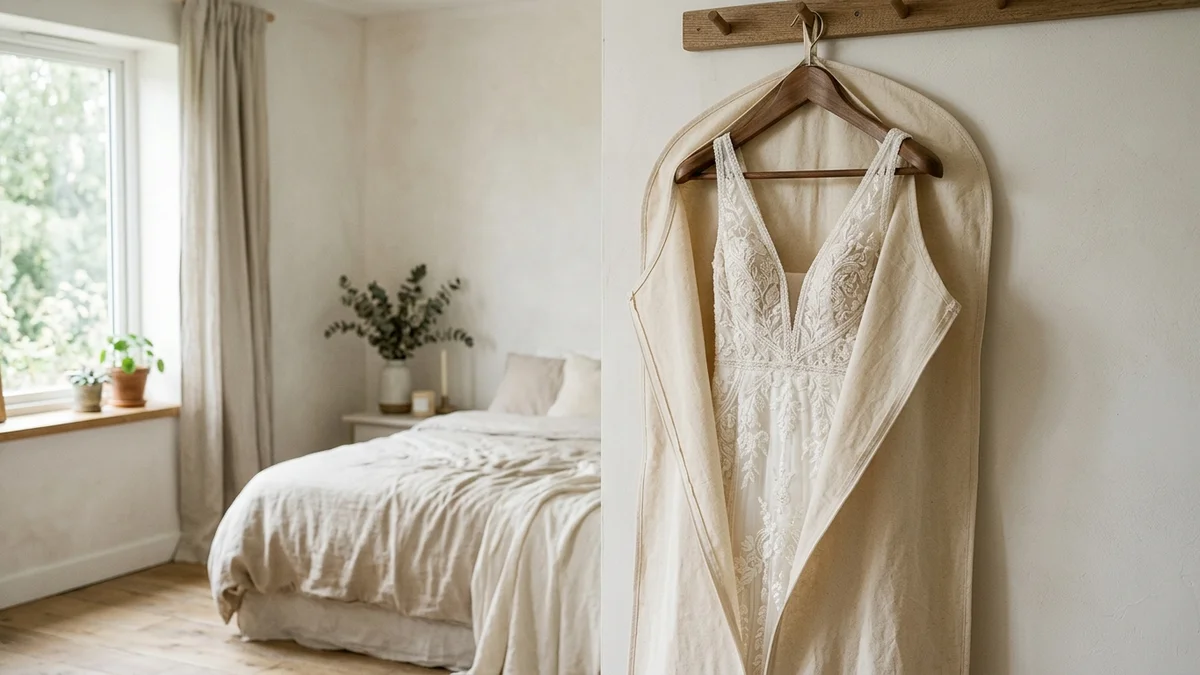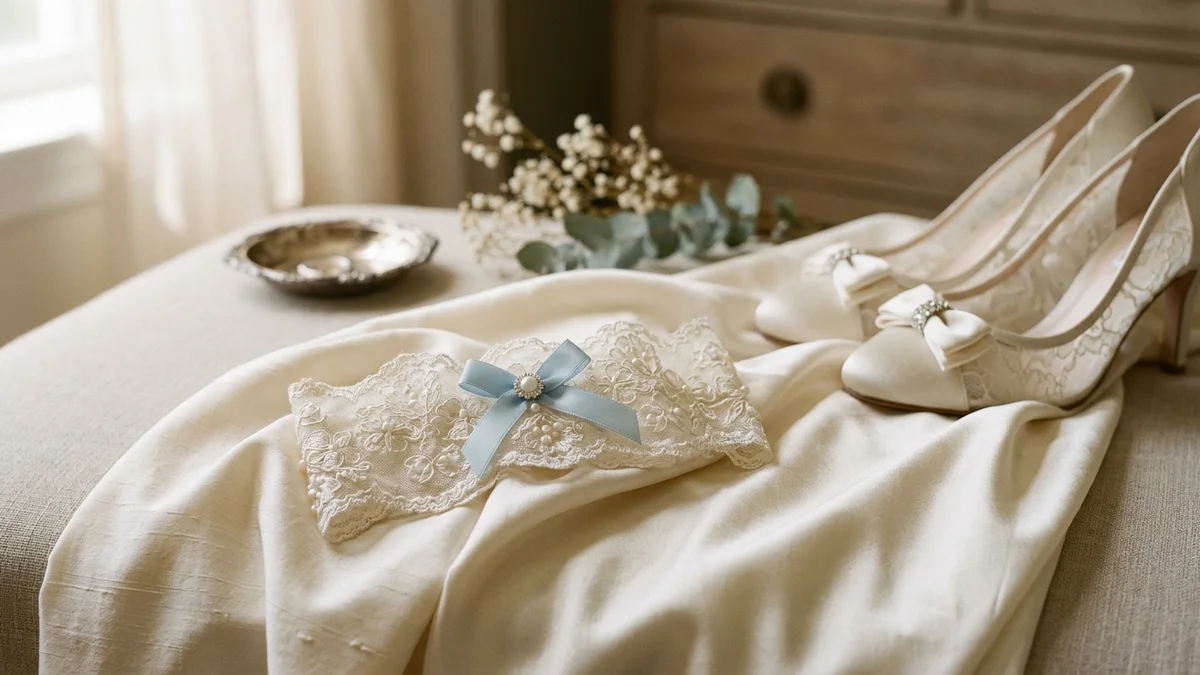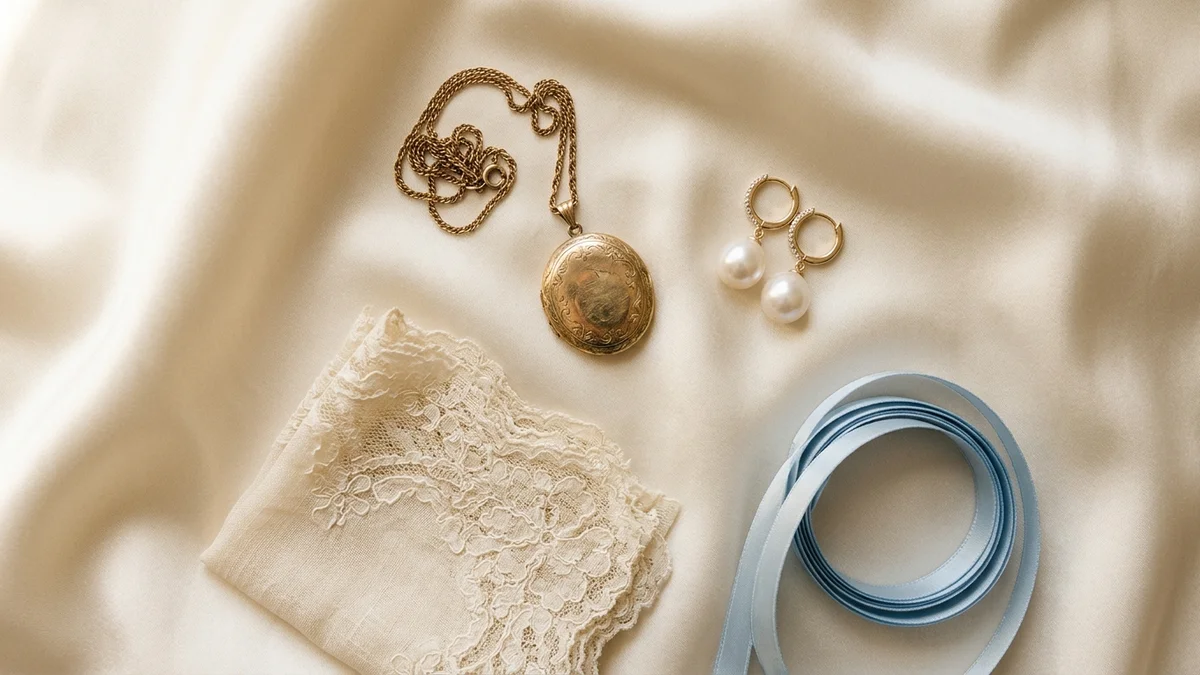
Three weeks out, someone at your bridal shower asks what you've picked for "something borrowed." And you realise you have a vague plan for blue, nothing for old, and no idea that borrowed came with rules.
Here is the thing nobody says out loud: this tradition is supposed to be the easy part of wedding planning. It became another checklist item somewhere along the way, and brides now stress about sourcing four objects that were originally meant to be whatever was already lying around the house.
This guide gives you the meaning of each item, where the rhyme actually came from, concrete ideas for all four, and the fifth line most brides have never heard. Updated in July 2026.
Key takeaway: "Something old, something new, something borrowed, something blue" is a Victorian English rhyme in which each item carries a wish for the marriage: continuity with the past, optimism for the future, borrowed luck from a happily married friend, and blue for fidelity. The full version ends with a fifth line, "and a silver sixpence in her shoe," for prosperity.
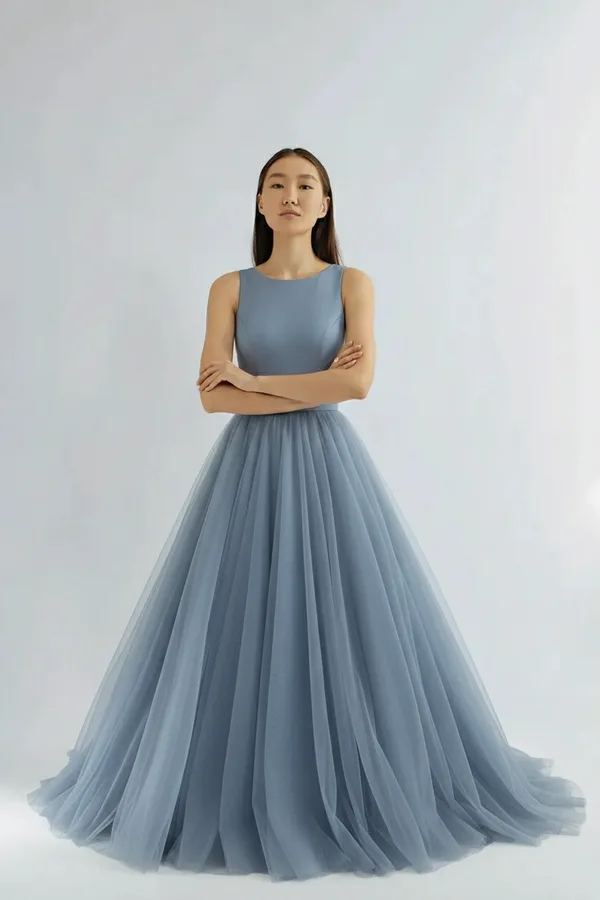
See this dress on you, before the boutique
Upload one photo and preview this style on yourself in seconds. No appointment, no pressure.
 Her photo
What Does "Something Old, Something New, Something Borrowed, Something Blue" Mean?
Each item in the rhyme carries a specific wish for the marriage. Something old represents continuity with your family and past. Something new symbolises optimism for your future together. Something borrowed is meant to carry luck from a happily married woman. Something blue stands for fidelity, love and purity.
The rhyme is a good-luck charm, not a rulebook. Victorian brides used what they already owned. The modern pressure to buy four distinct, photogenic objects is a retail invention, not a tradition.
| Item | Represents | Traditional source | Easiest modern version |
|---|---|---|---|
| Something old | Continuity, family, your history | A relative's jewellery or lace | Grandmother's earrings or a locket |
| Something new | Optimism, the future, good fortune | The gown itself | Your wedding shoes or rings |
| Something borrowed | Borrowed luck and happiness | Lent by a happily married woman | A friend's veil or handkerchief |
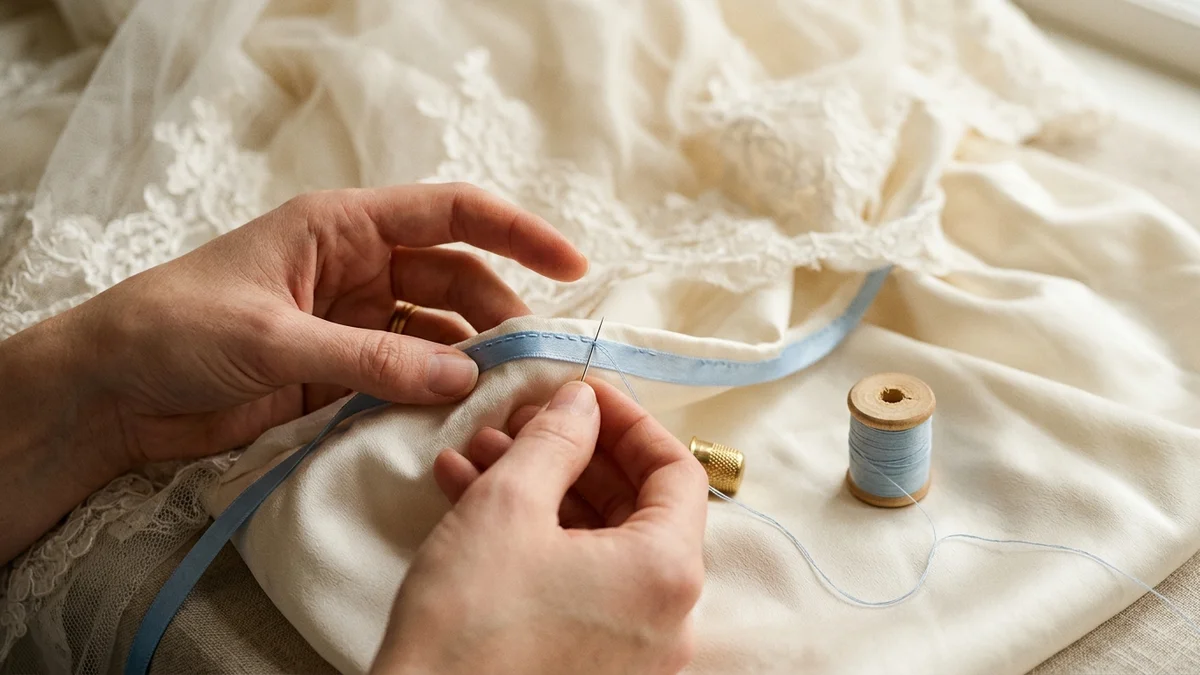
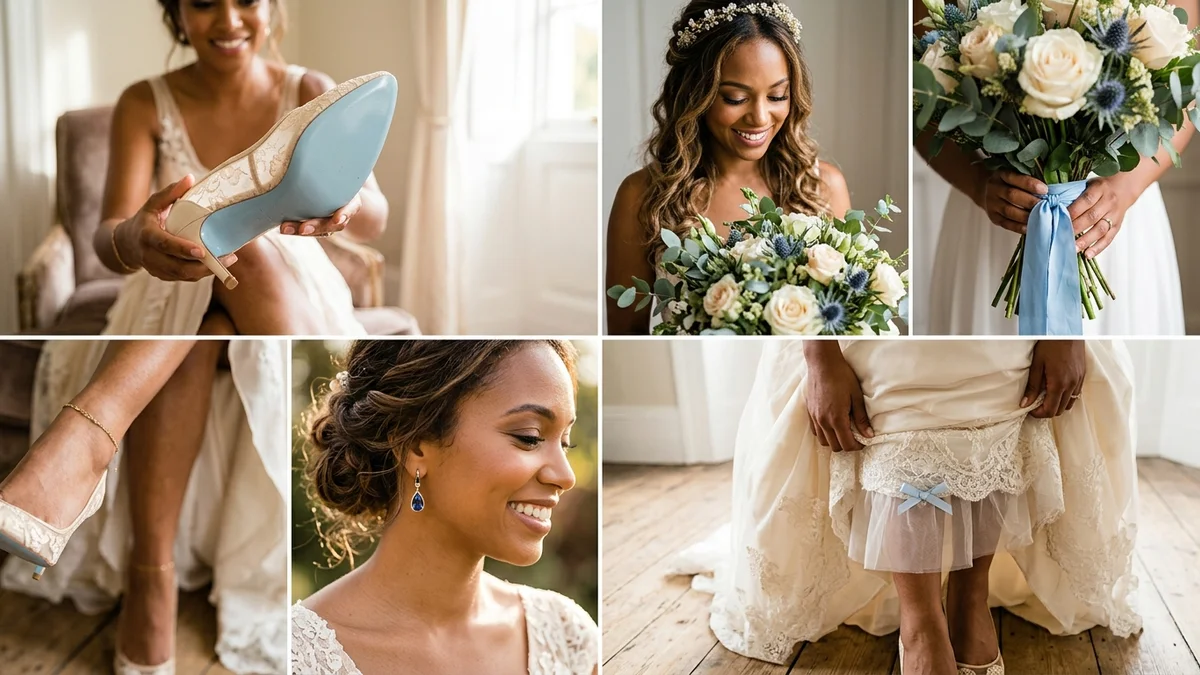
| Something blue | Fidelity, love, purity | A blue garter or hem ribbon | A blue ribbon stitched inside the hem |
| A silver sixpence | Prosperity and wealth | A coin in the left shoe | A dated coin from your birth year |
Bridal Consultant Tip: Do not buy four new objects to satisfy a rhyme about not buying things. Walk through your own jewellery box and your mother's first. The items with a story photograph the same as the ones with a receipt, and they mean considerably more in twenty years.
The Forgotten Fifth Line Most Brides Never Hear
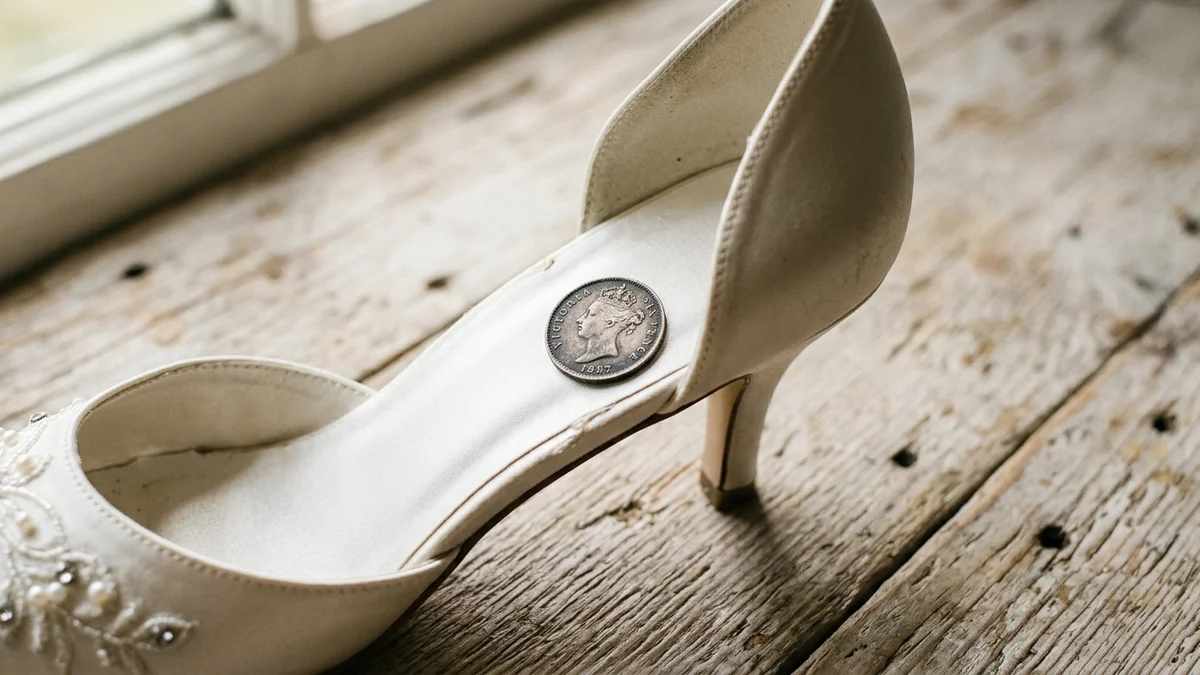
The rhyme did not stop at blue. The complete Victorian version runs: "Something old, something new, something borrowed, something blue, and a silver sixpence in her shoe."
The sixpence, a small British silver coin, was tucked into the bride's left shoe as a wish for prosperity. According to Mental Floss's history of the poem, the line is a late Victorian addition that dropped out of common use, largely because Britain stopped minting sixpences in 1967 and the coin became hard to find.
It is the single easiest way to make your version of the tradition feel less generic than everyone else's. A coin minted in your birth year, or your parents' wedding year, costs a few pounds online and gives you a story worth telling.
Where the Rhyme Actually Comes From
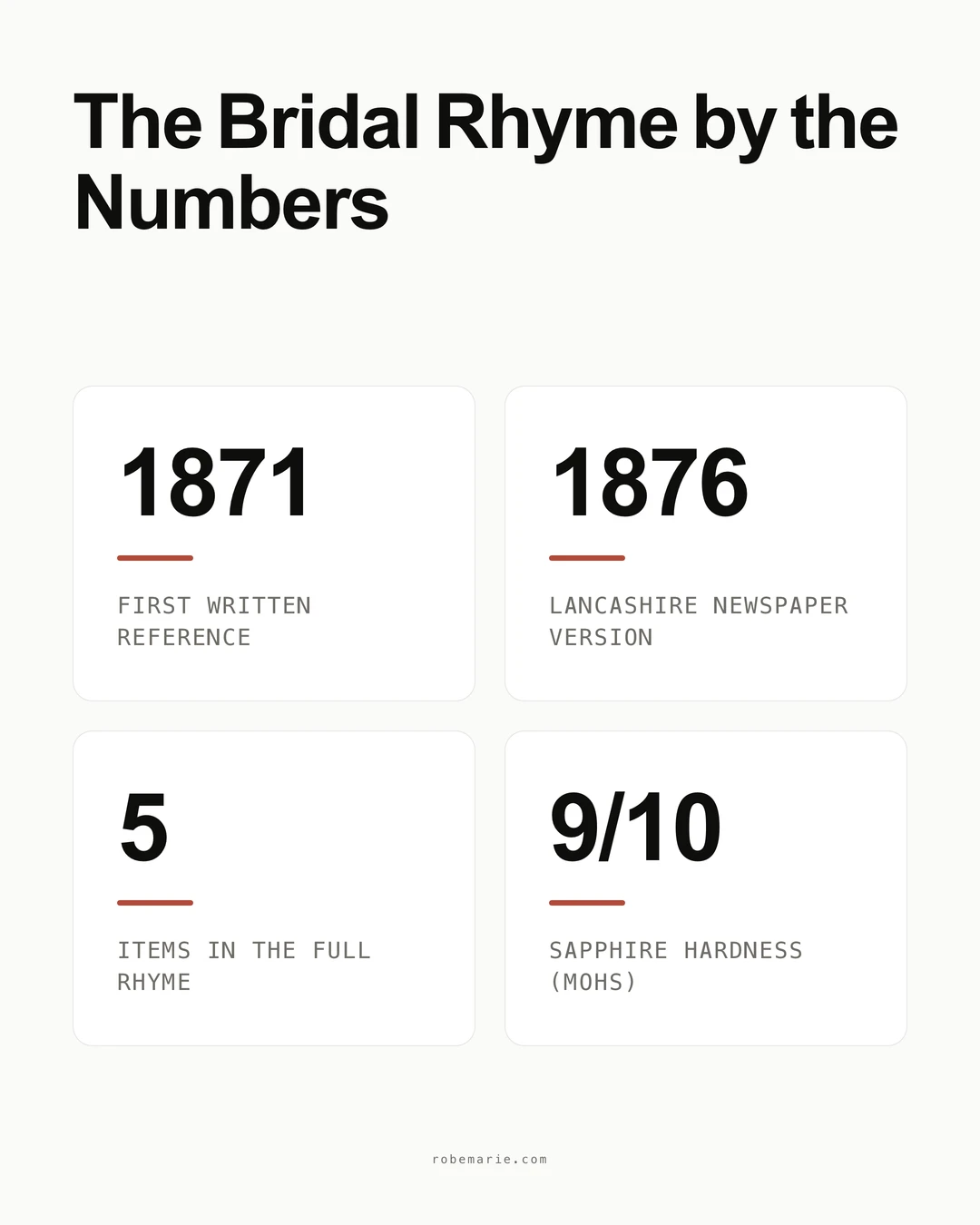
The earliest known written reference appears in an 1871 issue of The St James's Magazine, in a story titled "Marriage Superstitions, and the Miseries of a Bride Elect." The version closest to the one we use today was recorded in a Lancashire newspaper in 1876, describing a bride who wore "according to ancient custom, something old and something new, something borrowed and blue."
So the tradition is English, provincial, and roughly 150 years old. It is not ancient, not Roman, and not biblical, despite what a great many wedding blogs assert. Wikipedia's entry on the tradition and the Phrase Finder's origin research both trace it to this same Victorian window.
Why does this matter to you? Because knowing the tradition is a 19th-century folk charm rather than a sacred obligation gives you permission to bend it. Victorian brides certainly did.
Something Old: How to Choose Without the Guilt
The trap with "something old" is family politics. Two grandmothers, one brooch, and someone's feelings are about to get hurt.
Ideas that work:
- A relative's earrings, locket, or ring (worn, or pinned inside the dress)
- A piece of lace from a mother's or grandmother's gown, sewn into your hem
- A handwritten recipe card or letter folded into your bouquet wrap
- Your parents' wedding date embroidered in thread inside the bodice
- A vintage hair comb or hairpin
If the family politics are real, use more than one. Nothing in the rhyme says "something old" must be singular. Two small items pinned inside the dress, one from each side, solves the problem completely and nobody sees the seam.
If there is no heirloom to inherit, an object does not have to be a family antique to be old. A book you loved as a child, a ticket stub, a piece of jewellery you bought yourself at a turning point. Old means has history with you.
Something New: The One You Have Already Solved
This is the easiest of the four, and most brides overthink it.
Your dress is something new. So are your shoes, your rings, your veil, and your perfume. If you bought anything for this wedding, the box is ticked.
If you want it to feel deliberate rather than accidental, pick the item you will keep using afterwards: a perfume you will wear on anniversaries, or earrings that will outlive the dress. The point of "new" is optimism about the future, so choose the thing with the longest future.
Bridal Consultant Tip: Choose a perfume you have never worn before and wear it only on the wedding day and your anniversaries. Scent memory is far stronger than visual memory. In ten years, one spray will put you back in that room more vividly than the photographs will.
Something Borrowed: The Etiquette Nobody Explains
Something borrowed carries the most actual etiquette of the four, and almost every guide skips it.
The tradition specifies the lender. The item should come from a happily married woman, because you are symbolically borrowing her good fortune. Borrowing from a friend going through a divorce technically defeats the purpose, though nobody is checking.
It must be returned. This is the part people forget. It is a loan, not a gift, and the luck is understood to travel back with the object. Give it back within a week or two, cleaned, with a thank-you note.
Do not borrow something irreplaceable. Wedding days involve champagne, dancing, tears, and lost earrings. Never borrow anything a friend would be devastated to lose. If she hesitates for even a second when you ask, choose something else.
Good borrowed items: a veil, a handkerchief, a clutch, a hair comb, a bracelet, a mother's earrings.
| Borrow this | Not this | Why |
|---|---|---|
| A handkerchief or veil | An irreplaceable heirloom ring | Small, low-risk, easy to return intact |
| A clutch or hair comb | Anything a lender hesitated over | Hesitation means the answer is no |
| A bracelet or earrings | Shoes in the wrong size | Comfort outranks symbolism, always |
Something Blue: Hidden, or Visible?
Blue is where brides have the most freedom and the most decision paralysis. The real question is not what blue, but where: hidden against your skin, or visible in the photographs.
Both are traditional. A hidden blue is private, a small secret you carry through the day. A visible blue becomes part of your look and shows up in the album forever. Neither is more correct.
| Placement | Visibility | Best for |
|---|---|---|
| Ribbon stitched inside the hem | Hidden | Brides who want tradition, not a styling change |
| Blue thread embroidery (initials, date) | Hidden | Sentimental brides, easy to DIY |
| Garter | Hidden | Classic, if you are doing a garter at all |
| Sole of the shoe | Semi-hidden | Photographers love it, costs nothing |
| Bouquet wrap or stem ribbon | Visible | Adds colour without touching the dress |
| Blue earrings or a pendant | Visible | Doubles as your something old or new |
| Veil trim or blue-threaded edge | Visible | See our wedding veil guide for veil styles |
| The dress itself | Fully visible | Covered in our blue wedding dress guide |
If you want blue to run through the whole day rather than sit on one object, the wedding party is the natural place to put it. Our blue bridesmaid dresses guide breaks down which shades hold up in photographs, and a blue wrap works the same way, as covered in the wedding shawl guide.
Why a Sapphire Became the Ultimate "Something Blue"
If you want your blue to be an object rather than a detail, it is worth understanding why blue gemstones dominate this tradition.
Blue sapphire has meant fidelity and constancy in European tradition for centuries, which maps precisely onto what "something blue" is supposed to represent. It is also the practical choice: sapphire scores 9 on the Mohs hardness scale, second only to diamond, so it survives a lifetime of daily wear in a way that softer blue stones such as topaz or aquamarine do not.
The most photographed example in the world is the Ceylon sapphire engagement ring that Prince Charles gave Diana in 1981, and that Prince William later gave Catherine: a 12-carat oval blue sapphire framed by 14 diamonds in white gold, documented in detail by The Court Jeweller. "Ceylon" refers to Sri Lanka, still the origin most associated with the cornflower blue that made that ring famous.
Origin and treatment are what separate two sapphires at wildly different prices, and neither is visible to the eye. Most sapphires on the market are heat-treated to deepen colour; untreated stones with documented provenance are considerably rarer. Specialists such as the Paris gemstone house Joalys, which sells certified loose sapphires by origin and treatment, publish carat weight, clarity and provenance per stone, which is the level of detail worth asking for before you buy any coloured gem.
The market is moving your way: In The Plumb Club's 2025 bridal jewelry study, a survey of more than 2,000 US buyers, quality ranked as the single most important purchase factor for 39% of them, ahead of design (21%), price (17%) and brand (6%). Quality has climbed 25 points since 2023. Asking about origin and treatment is no longer a specialist question, it is what the market now rewards.
Bridal Consultant Tip: If you are buying a blue stone as a keepsake rather than a costume piece, ask two questions: has it been heat-treated, and what is the documented origin? A seller who cannot answer both in writing is not selling you a gemstone, they are selling you a colour.
When You're Three Days Out and Still Missing "Borrowed"
It is Wednesday. The wedding is Saturday. You have old, new and blue sorted, and every friend you would have asked is already travelling.
Do not buy something to solve this. Borrowed is the one item that categorically cannot be purchased, and a last-minute panic buy is the one version of this tradition that means nothing at all.
What actually works, in order:
- Ask your mother, grandmother, or an aunt. They are the most likely to say yes instantly and the most likely to be moved that you asked.
- Ask on the morning. Your bridal party will be in the room with you, wearing jewellery. Someone will hand you an earring or a bracelet within thirty seconds.
- Borrow something with no monetary value. A hairpin. A handkerchief. Your dad's cufflink in your bouquet. The symbolism does not scale with price.
The tradition survived a century because it was designed to be improvised. You are allowed to solve it on the day.
See All Four Details Together Before the Day
Here is the practical problem: you choose these four items one at a time, over months, and you never see them together until the morning of. That is when brides discover the borrowed pearls fight the beading, or the blue reads grey against ivory rather than white.
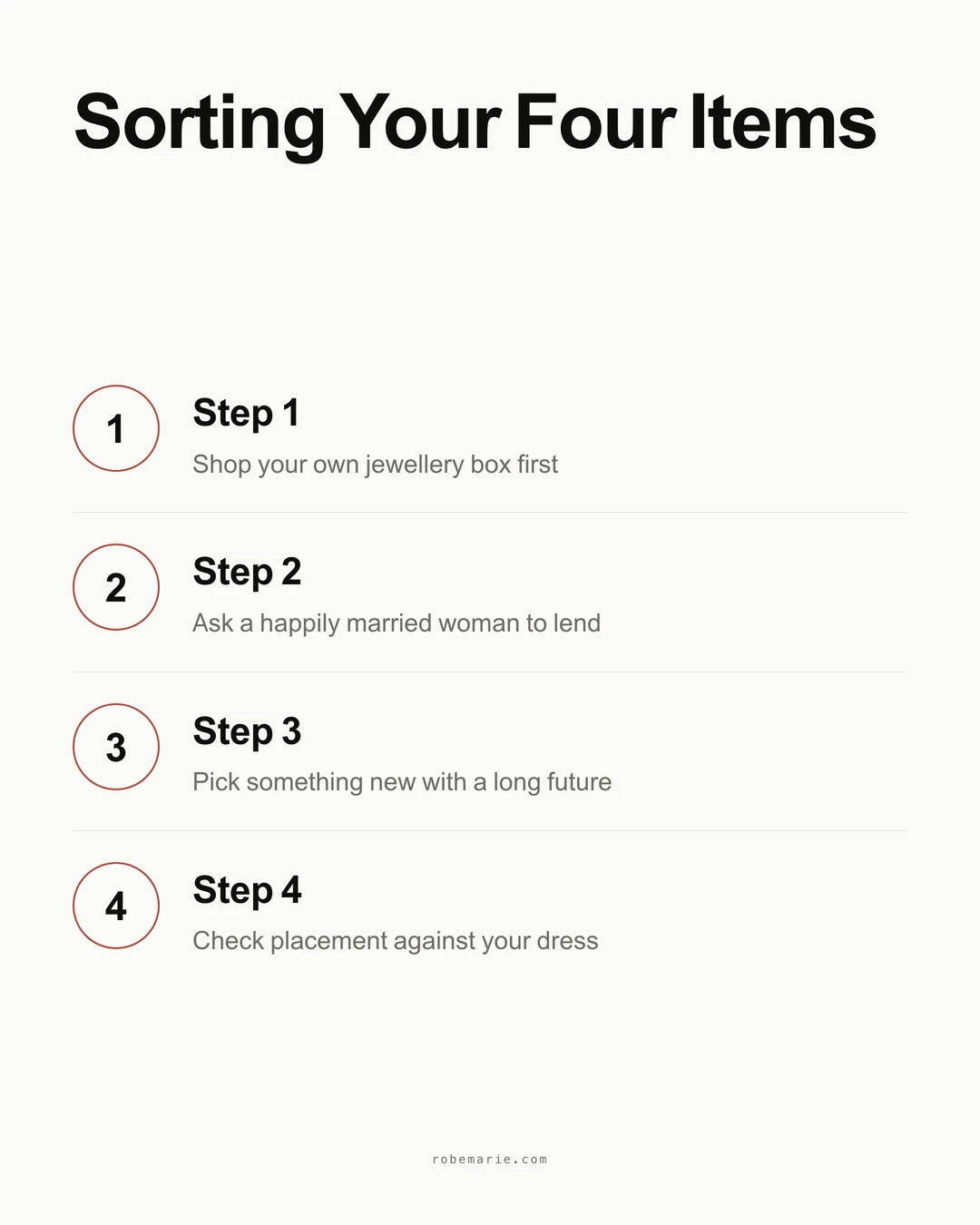
The fix is to look at your dress and your details as one picture, early. RobeMarie's virtual try-on lets you see a gown on your own body rather than on a model, so you can judge how a neckline sits and where a pendant or a blue accent would actually land before you commit to any of it.
RobeMarie Insight: The pattern we see most often is brides choosing accessories against a mental image of the dress rather than the dress itself. Necklines are the usual casualty: a pendant chosen for a sweetheart neckline frequently disappears against a high-neck or illusion bodice. Seeing the gown on your own frame first turns four separate decisions into one coherent look.
In the video above, the creator walks through real examples brides have used for each of the four items. Once you have a shortlist, RobeMarie's virtual try-on lets you check how those pieces sit against your actual gown and neckline rather than guessing.
Frequently Asked Questions
What is the full "something old, something new" rhyme?
The complete Victorian version is: "Something old, something new, something borrowed, something blue, and a silver sixpence in her shoe." Most modern versions drop the fifth line about the sixpence, which represented prosperity and was traditionally placed in the bride's left shoe.
Where does the something old something new tradition come from?
It comes from Victorian England. The earliest known written reference appears in an 1871 issue of The St James's Magazine, and a version close to today's wording was recorded in a Lancashire newspaper in 1876. The tradition is roughly 150 years old, not ancient.
Who is supposed to give you something borrowed?
Traditionally, a happily married woman, because you are symbolically borrowing her good fortune for your own marriage. The item is a loan rather than a gift and should be returned soon after the wedding, cleaned, since the luck is understood to travel back with the object.
Does a blue wedding dress count as something blue?
Yes. Wearing the colour itself is the most literal way to honour the tradition, and it means you can skip the hidden garter or ribbon entirely. Our blue wedding dress guide covers which shades photograph well and how to style them.
Can one item count as two things at once?
Absolutely. A grandmother's blue sapphire earrings are simultaneously old and blue. A borrowed veil with blue thread covers borrowed and blue. Nothing in the tradition requires four separate objects, and doubling up is both practical and common.
What if I forget one on the wedding day?
Nothing happens. It is a Victorian good-luck rhyme, not a binding ritual. If you notice in the morning, borrow an earring from someone in the room or slip a coin into your shoe. If you notice afterwards, your marriage is not affected in the slightest.
What is the best something blue if I don't want it visible?
A blue ribbon stitched inside the hem, blue thread embroidered with your initials or wedding date inside the bodice, or a blue garter. All three are completely invisible in photographs while still carrying the tradition, and the embroidery is easy to do yourself. If you are considering the garter, our guide to the garter toss tradition covers what the custom actually means and why wearing one without tossing it has become the mainstream choice.
Is a sapphire the only blue gemstone option?
No, but it is the most durable. Sapphire scores 9 on the Mohs hardness scale, while aquamarine sits around 7.5 to 8 and blue topaz around 8, making both more vulnerable to chipping with daily wear. For a keepsake you plan to wear for decades, sapphire is the safer choice.
Your Four Things, Sorted
The tradition was never meant to be a shopping list. It was a way of saying that a marriage carries your past with it, looks forward, leans on the people who love you, and stays faithful. Four small objects, one idea.
Pick what you already own where you can. Borrow from someone who will be pleased you asked. Put the blue wherever feels right, hidden or not. And if you want the fifth line, find a sixpence from a year that means something to you.
When you are ready to see how it all comes together on your actual dress, try RobeMarie's virtual try-on and view gowns on your own body before you commit. If the planning is starting to weigh on you, our guide to wedding stress covers what most couples find hardest, and why.