Three weeks before the wedding, it usually looks like this: a to-do list that grows faster than you can cross things off, a seating chart that restarts a family debate every time you open it, and a brain that waits until 2 a.m. to replay everything that could go wrong. If that sounds familiar, you are not doing this wrong. You are doing something genuinely hard, and your body is reacting exactly the way bodies react to hard things.
Key takeaways:
- Wedding stress is nearly universal: in a Zola survey of 500 engaged and newlywed couples, 96% said planning was stressful.
- Stress before a wedding is a normal response to real pressure, not a sign that something is wrong with you or your relationship.
- The five biggest triggers are logistics, budget, family, the feeling of being watched, and the weight of the commitment itself.
- Short daily tools like 4-7-8 breathing and heart coherence calm your nervous system in minutes, not weeks.
- If anxiety is constant, invasive, or focused on marriage itself rather than the event, it deserves real attention and possibly professional support.
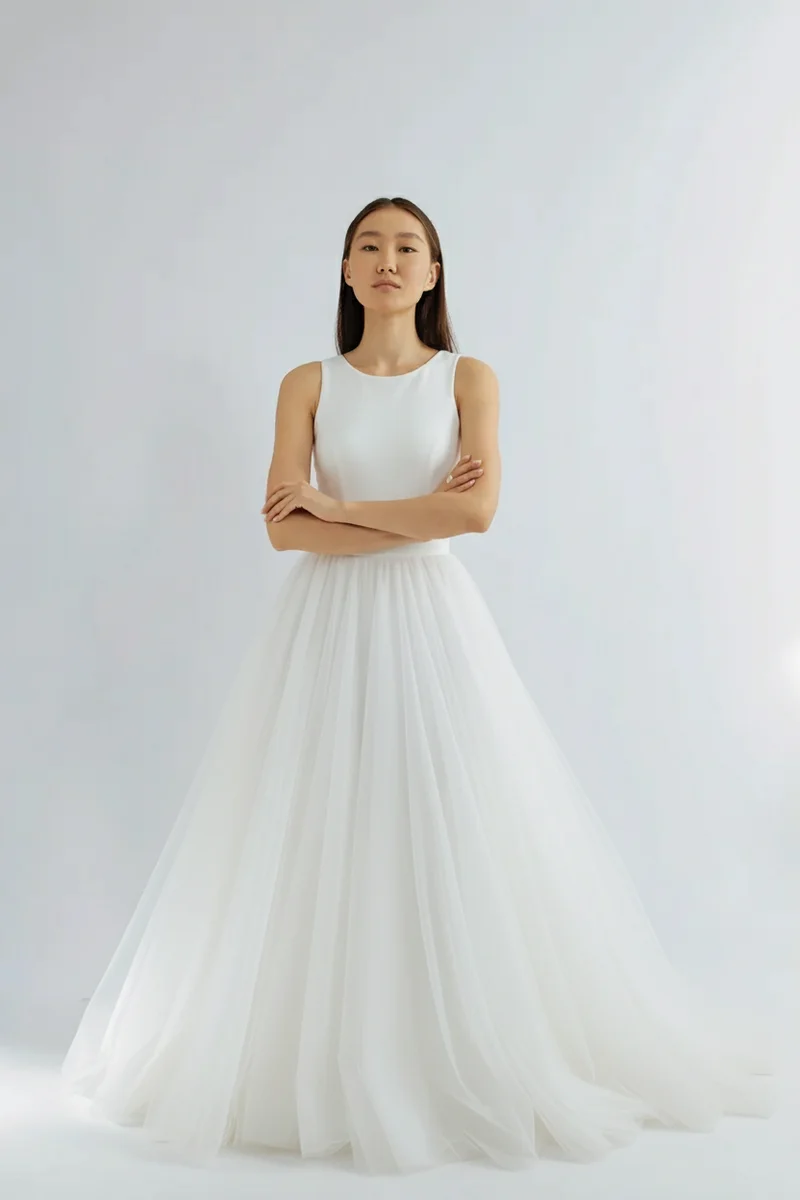
See this dress on you, before the boutique
Upload one photo and preview this style on yourself in seconds. No appointment, no pressure.
 Her photo
Is it normal to be stressed before your wedding?
Yes, stress before a wedding is normal, and the numbers back it up. In a survey of 500 engaged and newlywed couples by the wedding platform Zola, 96% said wedding planning was stressful, 40% called it very or extremely stressful, and 71% found it more stressful than major life events like buying a home or finding a job.
Think about what a wedding actually asks of you: run a one-day event for dozens of guests, manage a five-figure budget, navigate two families' expectations, and do it all while being the most photographed person in the room. Any project with those specs would stress a professional event planner. You are doing it for the first time, on top of your normal life.
There is one more layer people rarely name. A wedding is not just an event, it is a threshold. Even when you are sure of your partner, your brain registers "life is about to change" as something worth staying alert for. That alertness is stress. It is not a verdict on your relationship.
The 5 most common sources of wedding stress
Most wedding stress comes from five predictable places: logistics, money, family, social pressure, and the commitment itself. Knowing which one is loudest for you matters, because each one calls for a different fix.
1. The logistics avalanche
A wedding is hundreds of small decisions stacked into a few months: venue, vendors, timeline, menu, flowers, playlist, favors. Decision fatigue is real, and it is why choosing a napkin color can feel unreasonably heavy in month four. The fix is rarely working harder, it is cutting the number of decisions that reach you.
2. Budget pressure
Money stress shows up in almost every planning journey, and it compounds: every choice has a price tag, and the totals only move in one direction. In the same Zola survey, couples ranked budget among their top stressors, and more recent Zola data shows 60% of couples struggle most with managing their real budget against online inspiration. Set your numbers early, build in a buffer, and decide together which two or three things deserve the biggest share.
3. Family expectations
Weddings reactivate family dynamics like nothing else: who pays for what, who is invited, whose traditions win. You can love your family deeply and still find their opinions exhausting. This is the source of stress that most needs boundaries rather than better spreadsheets.
4. The feeling of being watched
For one day, every eye and every camera points at you. For many brides this crystallizes around the dress: will it suit me, will I recognize myself, will I feel exposed? A lot of that anxiety is really uncertainty, and uncertainty shrinks when you can see the answer ahead of time. It is exactly why we built our virtual try-on: seeing a dress on your own body, before any boutique appointment, replaces "I hope it works" with "I know how I look."
5. The weight of the commitment
Underneath the logistics sits the big one: you are making a lifelong promise in public. A wave of "this is huge" is a sign you are taking it seriously, not a sign you should not do it. Doubts that visit are normal. Doubts that move in and focus on marriage itself are a different topic, covered below.
What if it's something deeper? For some people the anxiety is not about the seating chart or the dress, it is about marriage itself: a persistent, intense fear of commitment that psychologists call gamophobia. It can affect people who genuinely love their partner, and it responds well to treatment. If that description rings truer than "planning overwhelm," read our full guide to gamophobia and the fear of marriage.
7 techniques that actually calm wedding stress
The techniques that work are the ones that either calm your body directly or remove pressure at the source. Here are seven worth actually doing, not just saving for later.
1. Breathe on a 4-7-8 rhythm
When your heart races, your breath is the fastest lever you have: inhale through the nose for 4 seconds, hold for 7, exhale slowly through the mouth for 8, repeated four times. It activates the parasympathetic nervous system, the body's built-in brake. If you want guidance instead of counting alone, the free wellbeing app Serena has a guided 4-7-8 breathing technique to calm your nervous system, along with a gratitude journal and mood tracking. Two minutes, anywhere, including a bathroom stall at your own reception.
2. Practice heart coherence daily
Heart coherence is a simple rhythm: breathe in for 5 seconds, out for 5 seconds, for 5 minutes, ideally three times a day. Practiced regularly, it lowers your baseline stress rather than just rescuing you in a spike. This heart coherence breathing guide walks through the method step by step. It pairs well with a fixed slot: morning coffee, lunch, and right before bed.
3. Delegate for real
Delegating is not "asking for help while double-checking everything." Pick two or three people you trust, hand each a full domain (vendors on the day, family logistics, emergencies), and let them own it including the imperfections. Every decision that no longer reaches you is stress that no longer reaches you.
4. Keep a three-line gratitude journal
Wedding planning trains your brain to scan for problems. A gratitude journal retrains it: each evening, write three things that went right, including tiny ones. It sounds too simple to work, which is exactly why most people never test it.
5. Set boundaries with family early
One honest conversation beats months of simmering: "We love you, here is what we have decided, here is where we would love your input." Decide with your partner in advance which topics are open for discussion and which are closed. Then repeat the boundary calmly as many times as needed. Boundaries feel rude for about ten seconds and peaceful for months.
6. Protect one wedding-free ritual a week
Keep one recurring moment where the wedding is off-limits: a Saturday run, a movie night, a long walk with your partner where neither of you says the word "vendor." Your relationship is the point of all this. Give it airtime that is not logistics.
7. Design your wedding morning like a runway, not a race
Day-of stress is mostly a planning problem you can solve in advance: build a timeline with 30-minute buffers, hand your phone to a trusted person, eat real food, and schedule five minutes completely alone before the ceremony. Decide now that one thing will go wrong and that it will not matter. Something always does, and it never does.
Frequently asked questions
Is it normal to have doubts before getting married?
Yes, occasional doubts before marriage are common and usually reflect the size of the commitment rather than a problem with the relationship. Doubts become worth deeper attention when they are persistent, focused on the marriage itself rather than the event, or accompanied by physical anxiety symptoms. In that case, our guide to gamophobia explains the difference in detail.
How do I calm anxiety on my wedding day?
Use your body, not your thoughts: slow breathing on a 4-7-8 rhythm, a short walk, cold water on your wrists, and five minutes alone before the ceremony. Preparation also matters, so build buffers into the timeline and delegate all problem-solving to someone you trust for the day.
Why is wedding planning so stressful?
Wedding planning combines a large budget, hundreds of decisions, family dynamics, and social pressure inside a fixed deadline. In Zola's survey of 500 couples, 96% called it stressful and 71% found it harder than buying a home. It is a genuinely demanding project, not a character test.
How far in advance should I start planning to avoid stress?
Twelve to eighteen months is comfortable for most weddings, because it lets you make one or two decisions a week instead of ten. If your timeline is shorter, cut scope rather than sleep: fewer options compared, more decisions delegated, and tools that remove uncertainty early.
Can wedding stress affect my health?
Yes, sustained stress can show up physically. In the Zola survey, 86% of couples reported stress-induced symptoms like insomnia, headaches, or skin breakouts during planning. Daily decompression habits help, and if symptoms persist or feel overwhelming, talk to a healthcare professional.
Does wedding dress shopping have to be stressful?
No, most dress stress comes from uncertainty and time pressure, and both can be reduced. Start with our wedding dress styles guide to narrow the field, then use a virtual try-on to see shortlisted styles on your own body before booking a single appointment. Walking into a boutique with three tested favorites is a completely different experience from walking in blind.
You are allowed to enjoy this
Wedding stress is real, nearly universal, and manageable. Name your loudest trigger, calm your body daily with two minutes of breathing, delegate what you can, and remove uncertainty wherever a tool can remove it: presort silhouettes with our dress styles guide, see them on yourself with the free virtual try-on, and budget fittings ahead with our guide to alteration costs. The wedding lasts a day. The point of the day is the person standing next to you, and that part is already done.
This article is for general information only and is not a substitute for professional advice. If anxiety feels overwhelming, persistent, or starts to interfere with your daily life, please talk to a doctor or a mental health professional.