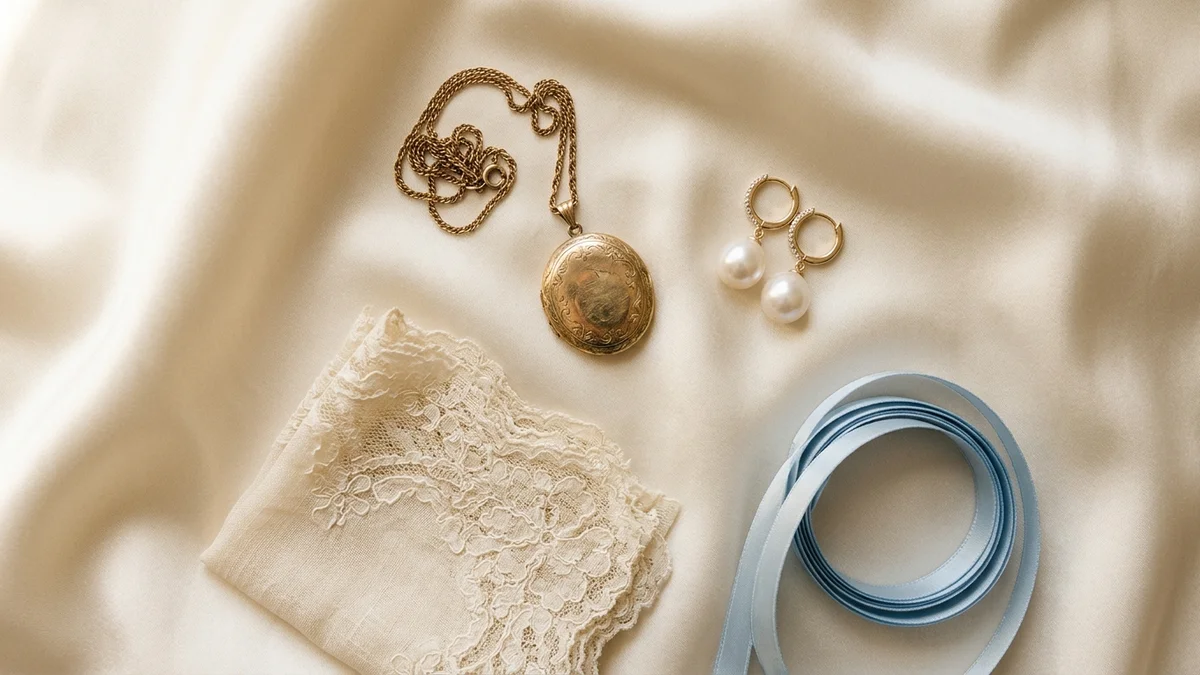
Somewhere around month nine of planning, a coordinator hands you a reception timeline and there it is, wedged between the cake cutting and the open dance floor: garter toss, 9:15pm. Nobody asked whether you wanted it. It is on the template because it has always been on the template.
And now you have to decide, quickly, in front of a spreadsheet, whether to keep a tradition you have only ever seen go one of two ways: charming, or the four minutes everyone quietly checks their phone.
This guide gives you what the garter toss actually means, where it came from (the real version, which is stranger than the reception version), how the moment runs when it works, and the alternatives couples are picking instead. Updated in July 2026.
Key takeaway: The garter toss is the reception moment where the groom removes a garter from the bride's leg and throws it to the unmarried men, mirroring the bouquet toss. It descends from a medieval European custom in which guests grabbed at the bride's clothing for luck, and the throw was the workaround that protected her. Most brides now wear a garter as a keepsake and a hidden "something blue" without tossing it at all.
See this dress on you, before the boutique
Upload one photo and preview this style on yourself in seconds. No appointment, no pressure.

 Her photo
What Is the Garter Toss at a Wedding?
The garter toss is a reception ritual in three beats: the bride sits on a chair in front of the guests, the groom removes a garter from her leg, then turns his back to the unmarried men and throws it over his shoulder. Whoever catches it is said to be next to marry.
It is the male counterpart to the bouquet toss, and the two are almost always scheduled back to back, bouquet first. At some receptions the two catchers are then paired for a dance, which is where the sequence earns its reputation for being either charming or excruciating, depending entirely on the room.
| Beat | What happens | Time needed |
|---|---|---|
| Bouquet toss | Bride throws the bouquet to unmarried women | 3 to 4 minutes |
| Garter removal | Groom removes the garter, seated bride | 1 to 2 minutes |
| Garter toss | Groom throws it over his shoulder to unmarried men | 1 minute |
| Optional pairing dance | The two catchers dance together | 3 minutes |
Timing-wise it belongs in the first third of the dance-floor portion of the evening: after dinner and the parent dances, before people start leaving. Fifteen minutes covers both tosses comfortably.
Bridal Consultant Tip: Decide the hem height before the day, not on the chair. Agree with your partner exactly how far the dress comes up and tell your photographer the plan. The version where the groom disappears under the skirt is a choice somebody made once, not a step in the tradition.
Where the Garter Toss Tradition Actually Comes From
The origin is far less tidy than the reception version, and it explains why the whole thing can feel slightly off to modern couples.
In medieval Europe, a marriage was not considered fully settled until the couple had gone to bed, so guests followed them to the bedchamber. A piece of the bride's clothing was believed to carry luck, which made the bride herself the target: people grabbed at her dress, her stockings, her garters. According to The Knot's history of the wedding garter tradition, the toss developed as a way to share that supposed good fortune in a controlled way rather than letting guests tear at the gown.
A related custom, sometimes called "flinging the stocking," had guests throw the bride's stockings back at the couple, with the thrower who hit a target considered next in line to marry. Over centuries the bedchamber part disappeared and the throw stayed.
So the honest lineage is this: the garter toss is not a romantic invention, it is crowd control that outlived the crowd. Couples react to that fact in both directions. Some find it makes the moment funnier and more human. Others decide a ritual built on grabbing at the bride is not one they need on their timeline. Both are reasonable readings of the same history.
What the Garter Means Today
Stripped of the history, the garter now does three separate jobs. Knowing which one you care about matters, because they point to different purchases.
| Job | What it means in practice | What to buy |
|---|---|---|
| Your "something blue" | Hidden, cheap, solves one line of the rhyme with no styling change | Any garter with a blue ribbon (most have one) |
| A keepsake | Kept in a box with the invitation and the pressed flowers | One garter, the nicer one, no toss version needed |
| A photo detail | Shot in the getting-ready flat lay and the leg shot | Something with texture: lace, pearls, a real ribbon |
The "something blue" job is why almost every garter sold has blue stitching or a blue ribbon. If you are still working through the other three items, our something old, new, borrowed, blue guide covers each one and the fifth line most brides have never heard.
The photo job has one practical catch: the garter lives inside the dress, so your photographer cannot shoot what they do not know exists. Mention it during the getting-ready block, alongside the rings and the shoes. Our guide to bridal getting ready outfits covers what else belongs in that sequence.

One Garter or Two?
Sets are sold in pairs for a practical reason: if you plan to toss, you throw one and keep the other. The tossing garter is the plainer of the pair, and it leaves the building with a stranger.
If you are not tossing, one is enough, and the budget goes into a piece worth keeping. What to look for at any price:
- Stretch lace rather than plain elastic. Elastic digs in and rolls down. Lace grips.
- Trim stitched down, not glued. Glued trim separates as soon as the band stretches, which it does the moment you sit.
- A band wide enough to distribute pressure. Narrow bands leave a mark and migrate.
That checklist is exactly how we chose the garter in our own shop: stretch lace, a satin bow, the blue ribbon already built in, at $24, sold singly or as a set of two. Bridal boutiques routinely price the same construction at $45 and upward, and the object is not different.
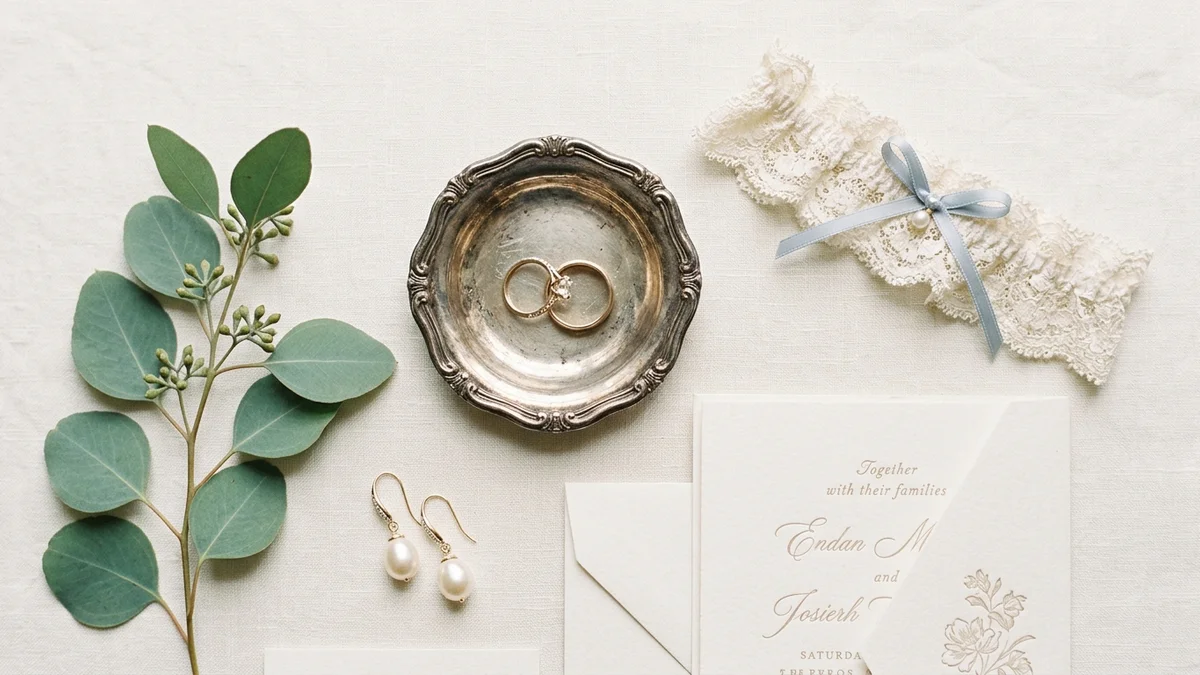
On sizing: most garters, ours included, are one size fits most, which makes this one of the very few bridal items you can safely buy a year out. Where sizing does exist it is by thigh measurement, not dress size. Measure while seated rather than standing, since that is the wider position and the one you will spend most of the reception in.
How the Garter Toss Runs, Step by Step
If you are keeping it, the moment works when it is fast and pre-agreed. It falls apart when the DJ improvises.
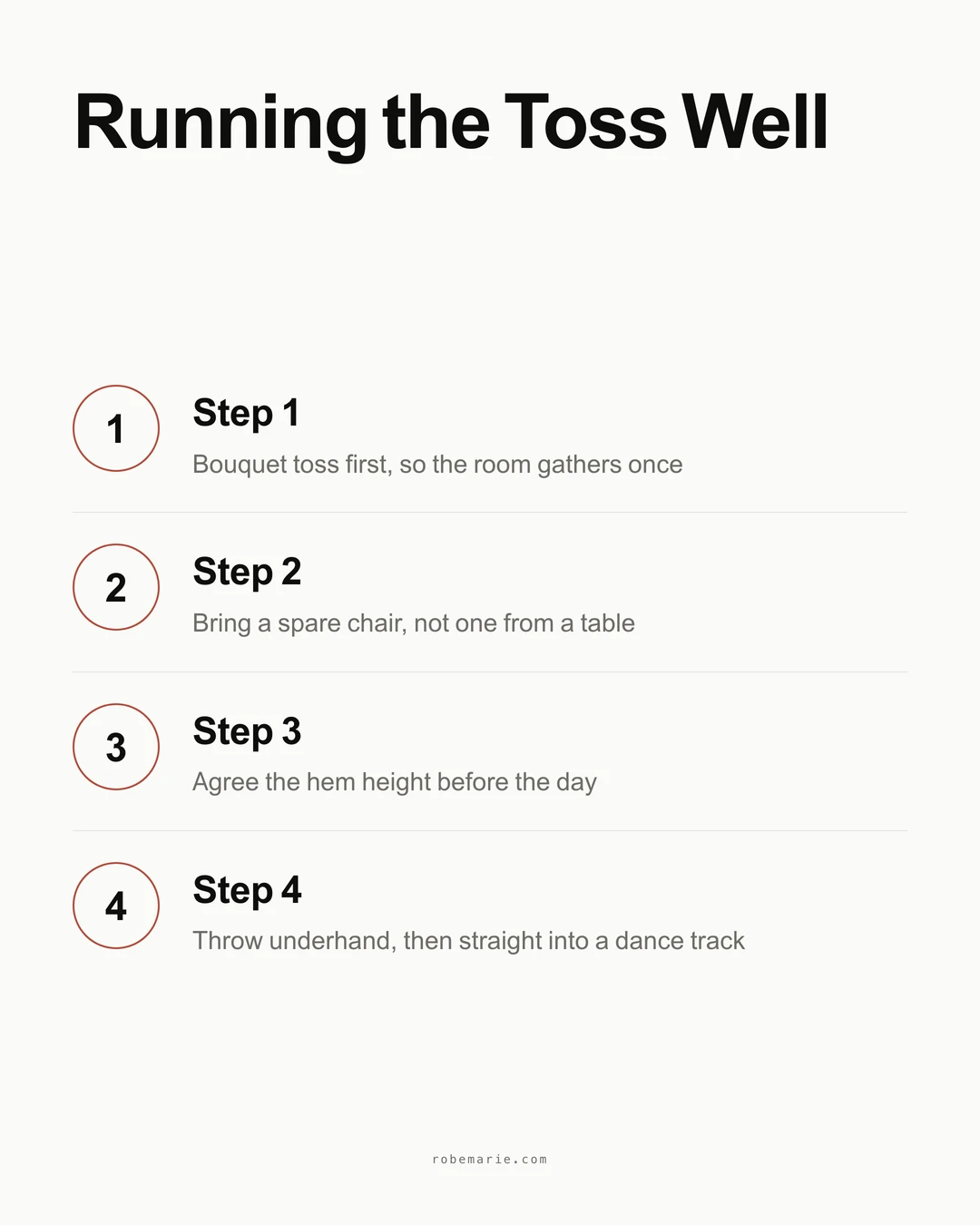
- Bouquet toss first, then the garter, so the room only gathers once.
- A spare chair gets carried to the middle of the floor. Not a chair pulled from a set table, one brought in advance.
- The bride sits, the dress is arranged to the height already agreed.
- The groom removes the garter, stands, and turns his back to the unmarried men.
- He throws it underhand and high over his shoulder. Not hard. The thing weighs almost nothing, so a hard throw goes straight down.
- The DJ moves immediately into a dance track. The pairing dance only happens if you decided in advance that your guest list can take it.
Bridal Consultant Tip: Put the tossing garter in your partner's pocket, not on your leg, if you are wearing two. Stacked garters are the most common reason this moment gets fumbled in front of a room: the wrong one comes off, or both do. One on the leg, one handed over ten seconds before.
Two practical notes. Brief your photographer on the order, because both tosses happen in about four seconds each and there is no second take. And brief the DJ on the song: a lot of standard garter-toss music was written as a joke and reads very differently to a grandparent than to a table of friends.
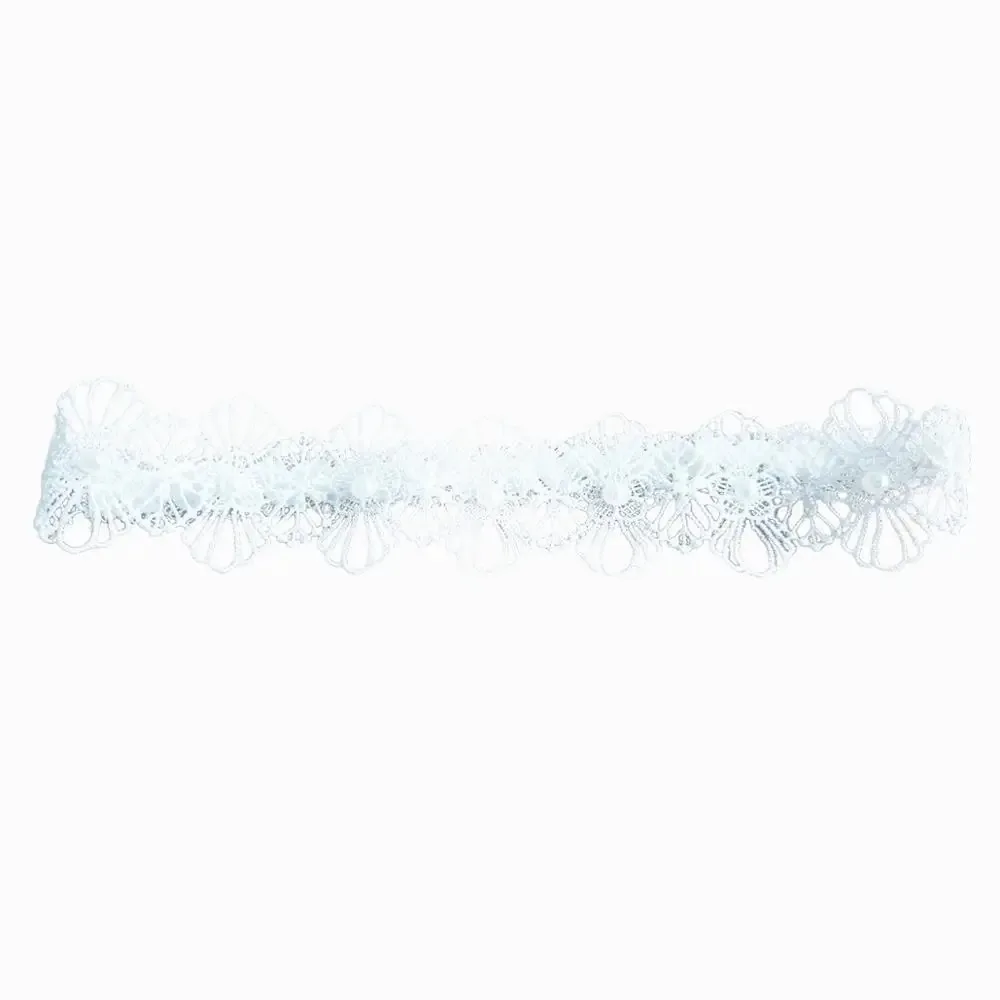
Which Leg, and How High?
There is no traditional answer, and anyone who tells you otherwise is repeating an internet rule rather than a custom.
Practically: wear it on whichever leg is more comfortable, at mid-thigh rather than just above the knee. Mid-thigh is where the leg is widest, so the band has something to grip. A garter sitting above the knee is the one that migrates downward over an evening. The trade-off is that your partner has to reach further, which is worth agreeing on in advance if you are tossing.
If you are wearing two, stack them on the same leg with the keepsake higher up, so the tossing garter comes off without dragging the other with it.
One fabric note: under a slim crepe or satin sheath, a wide lace band can read as a ridge through the fabric. If your dress is unforgiving, choose a narrow flat band, or wear the garter on the leg facing away from the aisle. This is the kind of thing you only ever notice in a full-length mirror, which is a good argument for settling the dress silhouette before you shop for anything worn under it.
When You Want to Skip It but Your Family Does Not
Here is the version of this problem that actually shows up. You have decided against the toss. Your mother, or your partner's mother, or an uncle who has been to four hundred weddings, treats it as non-negotiable. And you do not want the wedding to become a referendum on a garter.
Three things that defuse it, in order of how well they work:
- Replace it, do not delete it. "We are doing an anniversary dance instead" lands completely differently from "we are cutting the garter toss." You are offering a moment, not removing one. This resolves it most of the time on its own.
- Keep the object, drop the audience. Wear the garter. Let it appear in the getting-ready photos. Say so. Most of the attachment is to the tradition existing, not to the throw.
- Give the decision to the timeline, not to a person. "The band only has us until eleven and we would rather have the extra dancing" is a scheduling fact rather than a rejection of anyone's taste.
What does not work is agreeing in order to end the conversation and then hoping the DJ forgets. Somebody will have told the DJ.
Garter Toss Alternatives That Actually Work
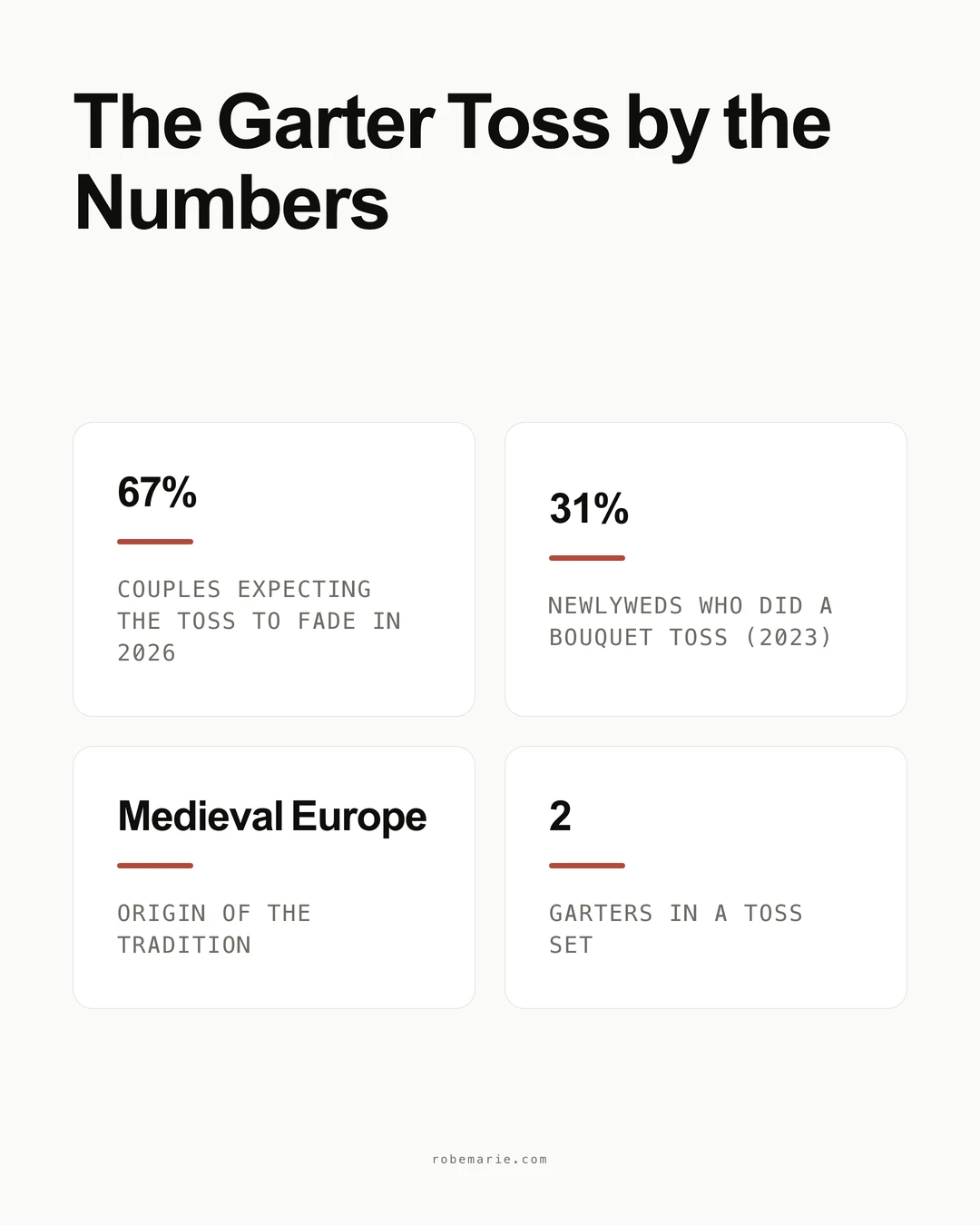
Couples are moving away from this one fast. In The Knot's Future of Marriage: 2026 Trends to Watch report, which compiled surveys taken through 2025, 67% of engaged couples said they expect the bouquet and garter toss to drop off in 2026. The bouquet toss itself was already down to 31% of newlyweds in The Knot's 2023 Real Weddings Study, and the garter toss trails it.
So if you skip it, you are not the outlier. You are the majority. The substitutions worth considering, drawn in part from The Knot's roundup of toss alternatives:
| Alternative | How it runs | Best for |
|---|---|---|
| Anniversary dance | All married couples dance, sit down as the DJ counts up the years, longest-married couple finishes alone | Mixed-generation guest lists. The one replacement that reliably moves a room |
| Bouquet toss alone | Exactly as normal, with nothing following it | Couples who like one half and not the other |
| Cake pull | Charms baked in with ribbons, guests pull for a prize | Southern receptions, and anyone wanting a group moment |
| Boutonniere toss | Groom tosses his boutonniere instead of a garter | Keeping the symmetry without the leg |
| Private handover | Garter given to a friend in the getting-ready suite | Keeping the keepsake logic, no audience |
| More dance floor | Skip both, extend the dancing by fifteen minutes | The most common choice, and nobody has ever complained |
The point worth holding onto: the garter is a piece of your outfit, and the toss is an item on a schedule. Two separate decisions. You are allowed to say yes to one and no to the other.
In the video above, the creator walks through what a garter actually is and runs through toss alternatives for couples who want to skip it. Once you have settled the dress, RobeMarie's virtual try-on lets you see the silhouette on your own body, which is what tells you whether a lace band will show through the fabric.

RobeMarie Insight: The pattern we see repeatedly is brides buying everything worn under the dress before they have settled the dress itself. Fabric weight is the deciding factor and it is invisible until you see the gown on your own frame: a lace garter that disappears under a structured ball gown reads as a visible ridge under a bias-cut crepe sheath. Seeing the silhouette on yourself first turns a guess into a decision.
Frequently Asked Questions
What is the garter toss at a wedding?
The garter toss is a reception tradition where the groom removes a garter from the bride's leg and throws it over his shoulder to the unmarried male guests. Whoever catches it is said to marry next. It mirrors the bouquet toss and is usually scheduled immediately after it.
What does the garter toss mean?
It comes from a medieval belief that a piece of the bride's clothing carried good luck, which led guests to grab at her garments after the ceremony. Throwing a garter into the crowd satisfied the custom without the bride being mobbed. Today it carries no obligation and functions mostly as a keepsake.
Where does the wedding garter tradition come from?
Medieval Europe, where a marriage was not considered final until the couple had retired for the night and guests followed them to the bedchamber. A related custom called "flinging the stocking" had guests throw the bride's stockings at the couple. The bedchamber elements faded over the centuries and the throw survived.
Which leg does the wedding garter go on?
Either one. There is no traditional side. Wear it at mid-thigh rather than above the knee, because that is where the leg is widest and the band has something to grip. If you are wearing two garters, put both on the same leg with the keepsake one higher.
Do I need one garter or two?
Two only if you plan to toss, so the one thrown into a crowd is not the one you wanted to keep. Sets are sold in pairs for that reason. If you are skipping the toss, one is plenty and the budget is better spent on a single piece worth keeping.
Is the garter toss still done in 2026?
Less and less. In The Knot's Future of Marriage: 2026 Trends to Watch report, 67% of engaged couples said they expect the bouquet and garter toss to fade in 2026. Wearing a garter without tossing it is now the mainstream choice, and the anniversary dance is the most common replacement.
What size wedding garter should I order?
Most are one size fits most, which makes the garter one of the few bridal items you can safely buy a year in advance. Where sizing exists it is by thigh measurement, not dress size. Measure while seated rather than standing, and size up if you are between sizes.
Will a garter show through my wedding dress?
It can, under bias-cut crepe, thin satin or any close-fitting sheath, where a wide lace band reads as a ridge. Structured gowns and layered skirts hide it completely. If your dress is lightweight, choose a narrow flat band and check it in a full-length mirror before the day.
The Garter and the Toss Are Two Decisions
The tradition is 600 years old, its origin is a crowd of people grabbing at a bride, and the throw was invented to protect her from them. That is worth knowing before you put it on a timeline at 9:15pm because a template said so.
Keep the toss if your room will love it, brief the DJ and the photographer, and run it fast. Replace it with an anniversary dance if you want the moment without the throw. Or wear the garter as a keepsake and a hidden something blue, let it appear in the flat lay, and give the fifteen minutes back to the dance floor. All three are correct.
When you are ready to see how the dress itself comes together, try RobeMarie's virtual try-on and view gowns on your own body before you commit to anything worn over or under them. And once the day is done, our guide to storing your wedding dress covers what to do with the gown, and the garter, in the weeks that follow.