You collected the dress after the final fitting, and now it is hanging on the back of your bedroom door in the bag the shop gave you, because where else would it go.
That sentence contains three mistakes, and together they cause most of the damage wedding dresses ever suffer. Almost none of it happens on the wedding day. It happens in the six weeks the dress waits at your house, and in the years after, when a gown that looked clean develops brown marks in a sealed box with nothing having touched it.
None of this is complicated to prevent. It comes down to what the dress hangs on, what it hangs in, where that is, and how fast it gets cleaned afterwards. Here is each one, plus an honest read on which part of the preservation industry is worth paying for. Updated in July 2026.
Key takeaway: Before the wedding, hang the dress by its interior ribbon loops on a wide shaped hanger, inside a breathable cotton garment bag, in an interior closet away from light and damp. Never leave it in the dry cleaner's plastic. After the wedding, have it cleaned within weeks, because sugar and alcohol stains are invisible at first and yellow later, then store it flat in an acid-free box rather than hanging it for years.
See this dress on you, before the boutique
Upload one photo and preview this style on yourself in seconds. No appointment, no pressure.

 Her photo
How Do You Store a Wedding Dress Before the Wedding?
Hang it by the interior ribbon loops on a wide shaped hanger, inside a breathable cotton garment bag, in an interior closet with space around it and away from light, radiators and damp. Remove the plastic bag it arrived in. If the gown is heavy or fully beaded, lay it flat in a box on acid-free tissue instead.
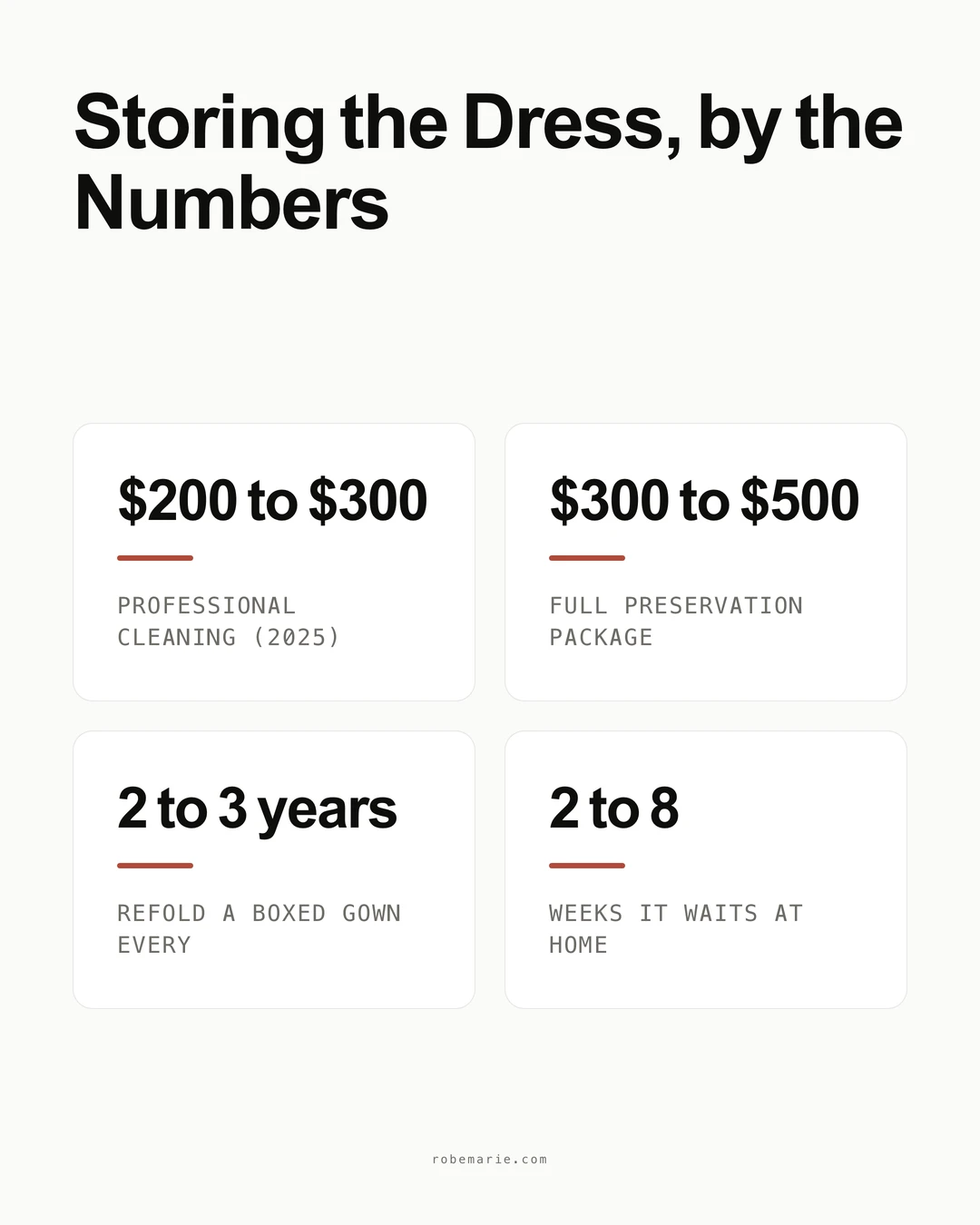
Most brides collect the dress somewhere between two and eight weeks out. Only three things go wrong in that window, and every piece of advice below is a fix for one of them.
| Problem | What causes it | What it looks like afterwards |
|---|---|---|
| Weight on the shoulders | Thin wire or plastic hanger under a heavy gown | A dent or crease at the shoulder seam that steam will not always lift |
| Trapped moisture | Sealed plastic bag, or a damp room | Faint musty smell, then a yellow cast along the folds |
| Light exposure | Hanging in daylight for weeks | Patchy yellowing on ivory and white, uneven across the fabric |
The Hanger, and the Loops Nobody Mentions
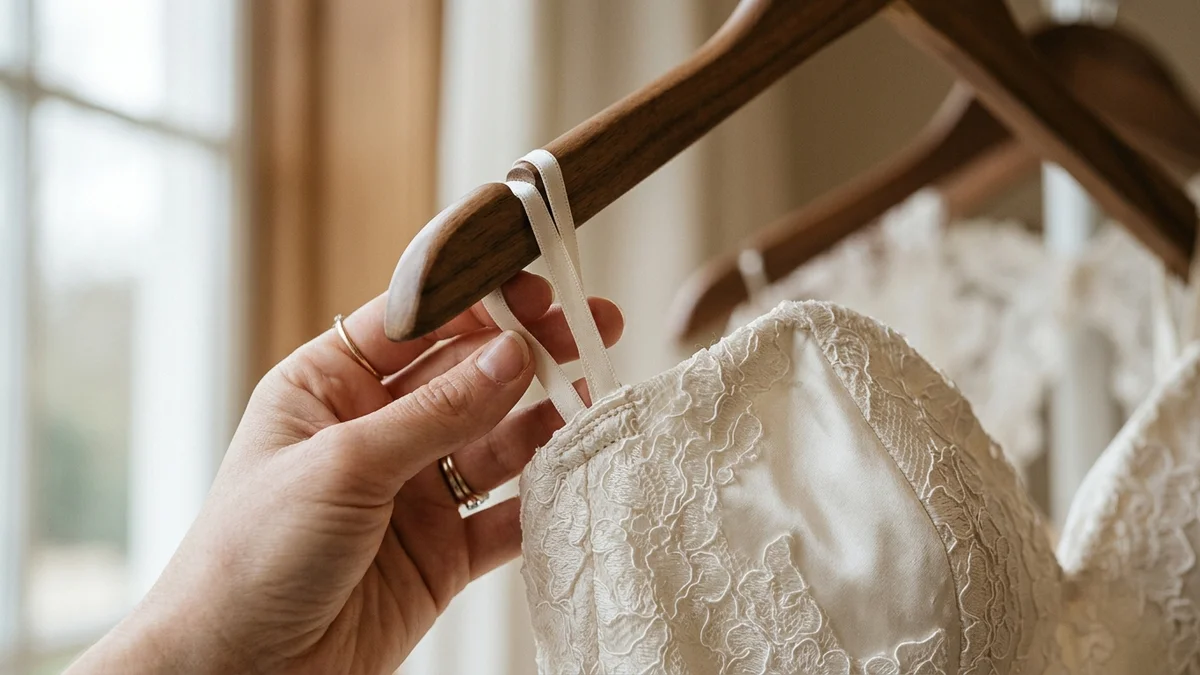
Look inside the bodice of your dress. There are almost certainly two narrow ribbon loops sewn into the side seams or the armholes. Those are hanging loops, and they exist because the dress is designed to hang from its internal structure rather than from your shoulders.
Use them. Loop them over the hanger and let the straps or sleeves hang loose. This transfers the load to seams built to carry it, and it is the single most effective thing you can do for a heavy or beaded gown.
Then the hanger itself. What matters, in order:
- Wide, shaped shoulders, so the weight spreads instead of concentrating on two narrow points.
- Notches for straps, so thin straps do not slide off and take the balance of the dress with them.
- Nothing that transfers. Avoid unfinished metal, which marks pale fabric, and heavily scented cedar, whose oils can stain silk.
This is also the object that appears in the first photograph of nearly every wedding gallery: the dress hanging alone before you put it on. That shot is why our wedding dress hanger exists at $24, with shaped wood, wide shoulders, strap notches and engraved lettering.
Worth being straight about what a hanger is and is not for, though. It is the right tool for the weeks before the wedding and for the photo. For long-term storage afterwards, a box beats any hanger, for reasons further down this page. Anyone selling you a hanger as an archival solution is overselling a hanger.
Bridal Consultant Tip: Buy the hanger before the dress pickup, not the week of the wedding. You want the gown to travel home and spend its waiting weeks on the right hanger. Arriving with it at the shop also means the staff transfer the dress for you, which is the one time it gets handled by someone who does this daily.
Throw Away the Plastic Bag
The dress will arrive in the bridal shop's plastic bag, or the dry cleaner's. Take it off.
Plastic is fine for one afternoon in a car. Over weeks it traps moisture against the fabric, and some plastics slowly release gases that yellow whites and can leave a faint film on beading. Archival suppliers are blunt about this: Gaylord Archival's guidance on preserving a wedding dress, written for the same audience that supplies museums, specifies acid-free and unbuffered materials and no plastic in contact with the textile.
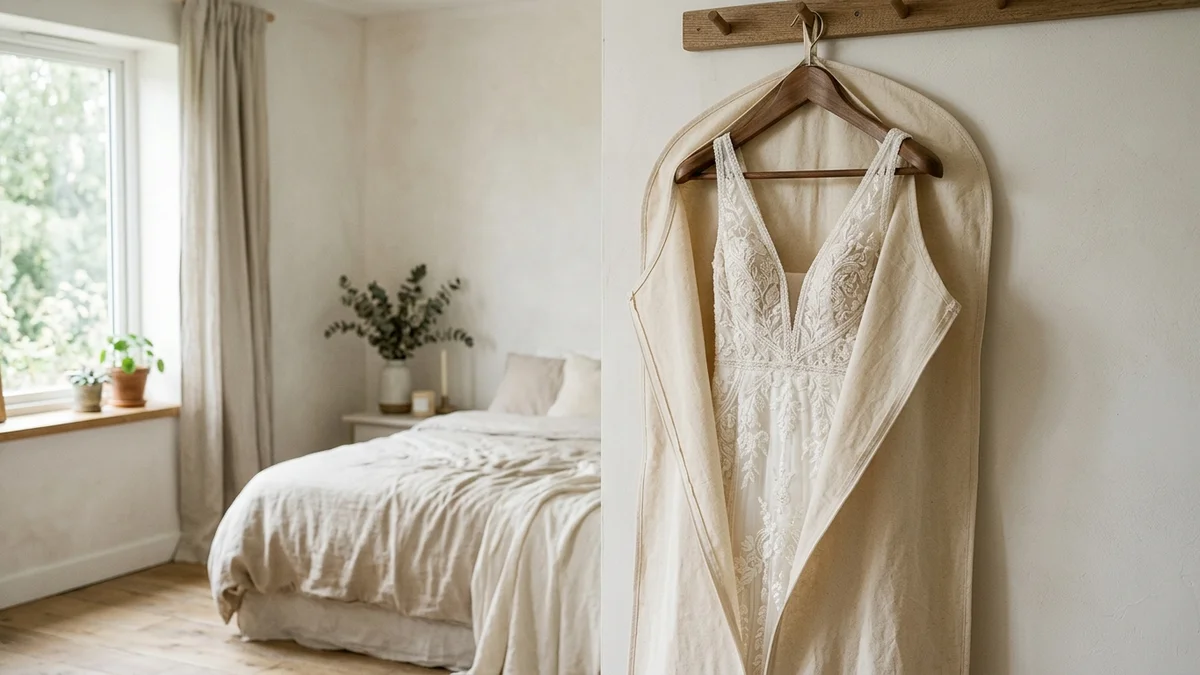
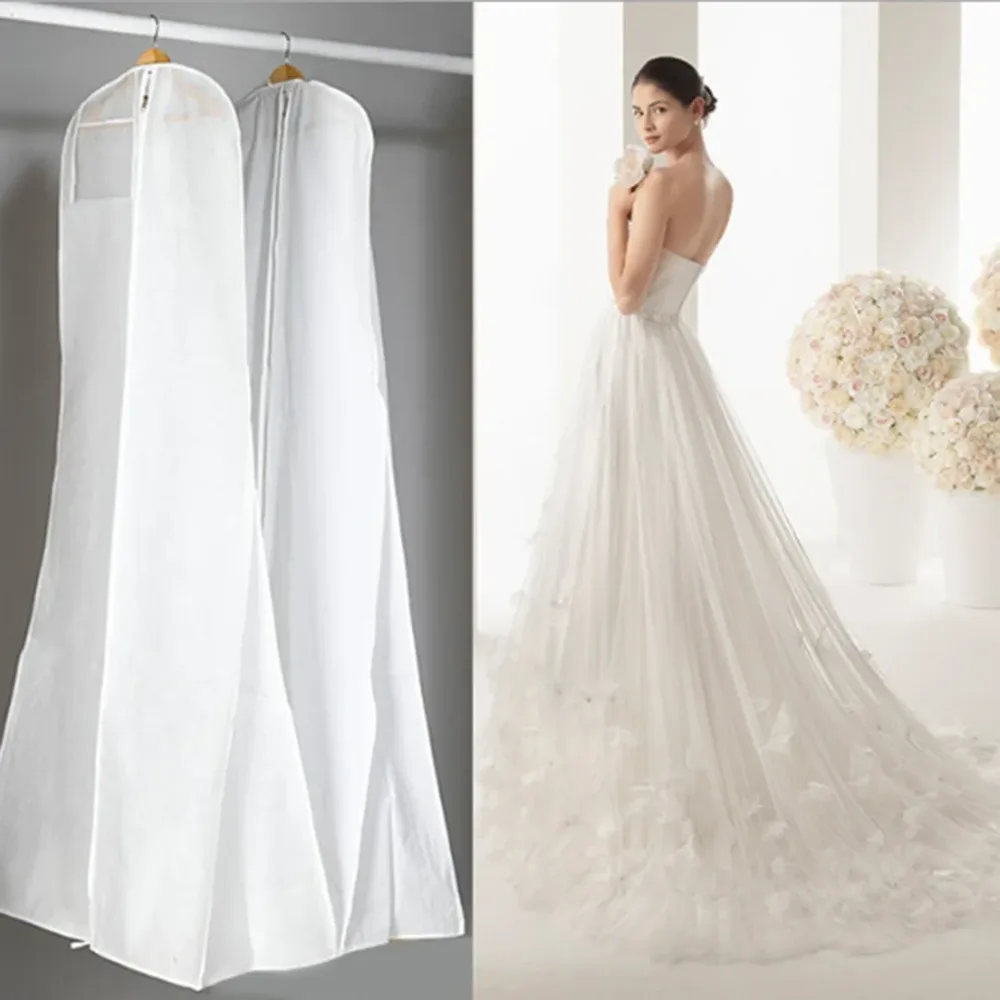
Replace it with a breathable cotton or unbleached muslin garment bag, full length so the hem is covered, and long enough that the dress is not folded upward inside it. Cotton is the conservation-grade answer; a full-length non-woven cover is the practical one, and it clears the bar that matters, which is that it is not sealed film. That is what our garment bag is, at $29, 180 cm long. If a train is too long for any bag you own, fold the excess into a soft cotton sheet rather than leaving it resting on the floor.
Where to Put It, Exactly
An interior closet, in the main body of the house. Not the following, which between them cover most of the places brides actually choose:
| Where | Why not |
|---|---|
| Attic or basement | Temperature swings and humidity, the two things fabric handles worst |
| Wardrobe against an exterior wall | Cold wall plus warm room produces condensation |
| Back of a bedroom door | Daylight, plus every knock the door takes |
| Near a radiator or in direct sun | Heat and UV, the fastest route to yellowing |
| Compressed between winter coats | Creases along whatever it was pressed against, and deformed bodices |
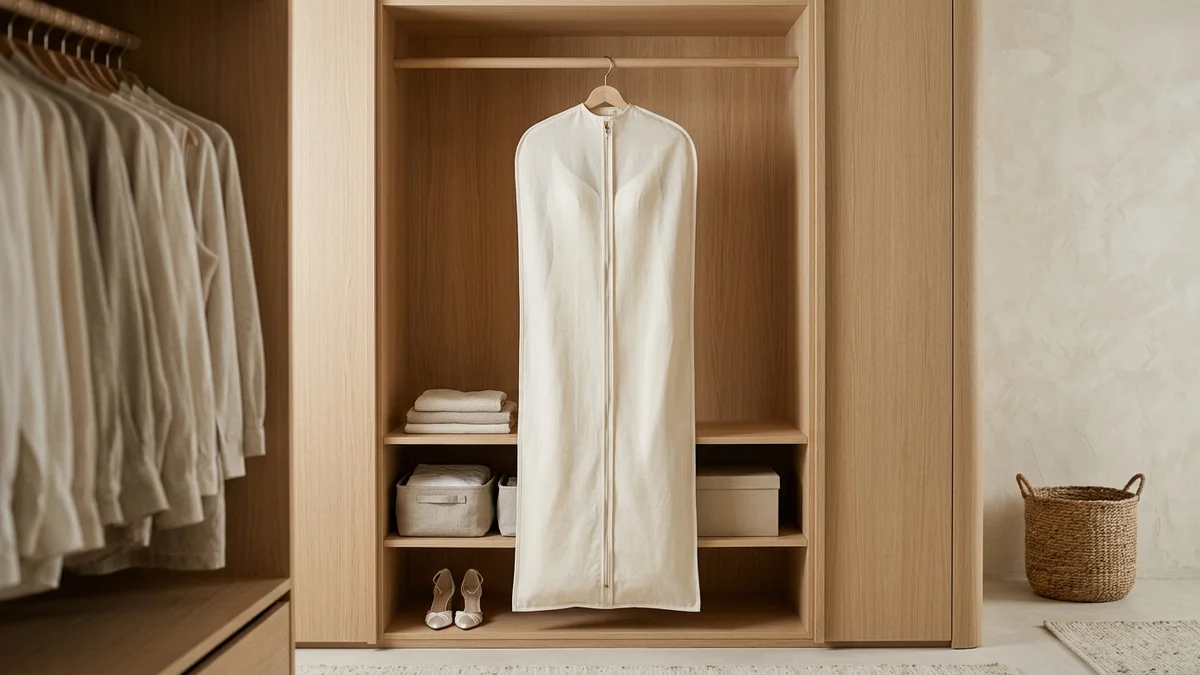
Give it room. Structured bodices deform under sideways pressure, so move things out of the way rather than squeezing the dress in.
If your gown is unusually heavy, beaded from top to bottom, or has a long structured train, consider not hanging it at all for those weeks. Lay it flat in a large box on acid-free tissue and take it out for one gentle steam a few days before. Heavy beadwork on a bias-cut fabric will stretch on a hanger, and that stretch is not always reversible.
Clean It Before You Store It
This is the urgent one, and the one most brides get wrong by waiting.
Champagne, white wine, sweat and the sugar in cake frosting all go on colourless and oxidise over time into brown marks. A dress that looks perfectly clean when you step out of it can develop stains six months later inside a sealed box. The dirt at the hem is the visible problem. The invisible one is what actually ruins gowns.
So: within a few weeks, not "eventually." Two routes.
A specialist bridal cleaner. Worth it for silk, structured couture, heavy beading, or anything with a hand-finished interior. Ask two questions before handing it over: is the cleaning done in-house or shipped out, and is the beading hand-checked and re-secured afterwards.
A regular dry cleaner who handles wedding dresses in volume. Fine for polyester and unbeaded synthetic gowns, which is a large share of dresses sold. Point out every mark, including the ones you cannot see, and say what caused each one. Solvent choice depends on the substance.
Bridal Consultant Tip: Write down every spill on the night, or have a bridesmaid do it. "Red wine, left hip, around ten" is worth more to a cleaner than the dress itself, because the solvent depends on the substance and by the time you drop it off, most of the marks will be invisible to both of you.
Either way, do not attempt a full home clean on silk or on anything beaded. Spot-treating a hem in cold water is reasonable. Putting a boned bodice through a washing machine is not.
What Wedding Dress Preservation Actually Costs
Preservation is cleaning plus archival packaging, and the cleaning is the part that matters. The market has settled into fairly clear tiers.
| Tier | Typical price | What you get |
|---|---|---|
| Dry cleaning only | $200 to $300 | Professional clean, returned on a hanger or in a bag |
| Budget mail-in preservation | $169 to $250 | Clean plus a basic acid-free box and tissue |
| Standard preservation package | $300 to $500 | Clean, acid-free box, tissue, usually a long-term guarantee |
| Premium or heirloom service | $500 to $1,000+ | Higher-grade materials, hand finishing, museum-style handling |
Those bands come from current industry pricing surveys, including Trusted Wedding Gown Preservation's 2025 breakdown of cleaning and preservation costs and the 2026 preservation cost guide published by WeddingGownPreservationKit, which puts most brides in the $300 to $500 range.
Where the money is genuinely well spent: silk, heavy beading, or a gown you intend to pass to a daughter or a niece. Where it is not: an unbeaded polyester dress kept for sentiment. In that case a professional clean plus your own acid-free box, acid-free tissue and a stable cupboard gets you most of the way for a fraction of the price. As a comparison point, a full preservation package often costs more than the alterations on the same dress, which is worth knowing before you agree to it at the shop counter.
Two things not to bother with. A sealed "museum" window box you can never open is a marketing object rather than a conservation one, because conservators specifically want to inspect and refold. And anti-yellowing treatments beyond a proper clean are unproven.
Long-Term: Boxed Flat, Not Hanging
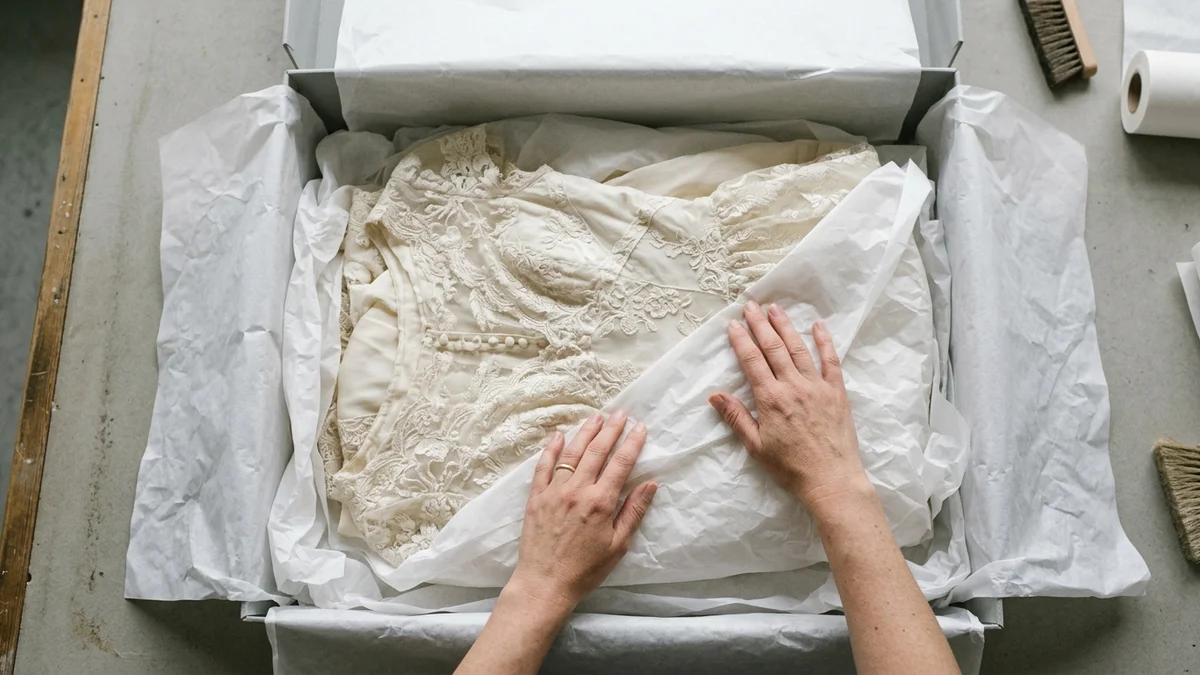
For decades of storage, flat and boxed beats hanging. This is where the hanger hands over to the box, and it is the switch most people never make.
Gravity works on a hanging dress continuously. Shoulder seams stretch, beadwork pulls, and a long train carries its own weight for twenty years. A box removes the load entirely.
| Before the wedding | Long-term after | |
|---|---|---|
| Position | Hanging | Flat |
| Support | Wide shaped hanger, interior loops | Acid-free box, acid-free tissue between folds |
| Cover | Breathable cotton bag | The box itself, no plastic |
| Maintenance | Steam a few days before | Refold every 2 to 3 years |
| Duration | 2 to 8 weeks | Indefinite |
The maintenance line is the one everyone skips. Creases become permanent along the same fold if the dress never moves, so refolding every two or three years is what actually keeps a boxed gown wearable. It takes ten minutes.
Also: stuff the bodice and sleeves with acid-free tissue so they hold their shape, wrap the surfaces so nothing is exposed, and fold at the waist with the bodice on top. Ordinary tissue paper and newsprint both contain acids that migrate into fabric and yellow it, so the "acid-free" part is not marketing language, it is the whole point.
In the video above, the folding and tissue-stuffing sequence is demonstrated end to end, which is far easier to follow visually than in writing. If you have not bought the dress yet, RobeMarie's virtual try-on lets you see gowns on your own body first, and a dress you were sure about is one you are far more likely to want to keep.
When You Are Not Sure You Want to Keep It
Nobody in the industry asks this, because the industry sells boxes. But it is the honest first question, and it is much easier to answer in the first year than in the tenth.
Keeping a dress is a real choice with a real cost: the clean, the box, the cupboard space, the refolding. If the plan is "someone might wear it one day," be aware that heirloom reuse is rarer than the preservation marketing implies, and that a gown boxed in 2026 will be a 2026 dress in 2056.
The alternatives are all reasonable:
- Sell it. Resale is strongest in the first two years, while the style is current, and it requires the same professional clean you would pay for anyway.
- Donate it. Several charities take gowns for brides who cannot afford one, and for bereavement gown programmes.
- Have it reworked. A shortened version, a christening gown, a wearable slip out of the lining. This is where a good alterations specialist earns their reputation.
- Keep it properly. The full clean-and-box route, done once, done right.
What is genuinely not an option is the fifth thing, which is what usually happens: leaving it uncleaned in the plastic bag in a spare room for four years and then discovering the decision has been made for you.
RobeMarie Insight: Dress regret and dress neglect travel together. In our experience the gowns that get cleaned promptly and stored properly are the ones the bride was certain about, and the ones that sit in a bag are usually the ones chosen under time pressure in a boutique. Seeing styles on your own body before buying is a storage decision as much as a shopping one: certainty is what makes a dress worth keeping.
Frequently Asked Questions
How do you store a wedding dress before the wedding?
Hang it by the interior ribbon loops on a wide shaped hanger, inside a breathable cotton garment bag, in an interior closet with space around it and away from direct light, radiators and damp. Remove the plastic bag. Very heavy or fully beaded gowns are better laid flat on acid-free tissue.
Can I keep my wedding dress in the plastic bag from the shop?
No. Plastic traps moisture against the fabric and some types release gases over time that yellow white and ivory. It is fine for transport and nothing longer. Replace it with cotton or unbleached muslin, which lets the fabric breathe while still keeping dust off.
How soon should a wedding dress be cleaned after the wedding?
Within a few weeks. Champagne, wine, sweat and cake sugar are colourless at first and oxidise into brown marks over months, so a dress stored uncleaned can develop stains that were invisible when you took it off. Cleaning first is what makes storage safe.
Is it better to hang or box a wedding dress long term?
Box it, flat, in an acid-free box with acid-free tissue between the folds and inside the bodice. Hanging for years lets gravity stretch shoulder seams and pull on beadwork. Hanging is for the weeks before the wedding, boxing is for the decades after.
How much does wedding dress preservation cost?
Most brides pay $300 to $500 for a full package, with budget mail-in services from around $169 and premium heirloom work running past $1,000. Professional cleaning alone was $200 to $300 in 2025. The cleaning is the substantial part; the box and tissue are the remainder.
What kind of hanger should I use for a wedding dress?
One with wide shaped shoulders to spread the weight, notches to hold straps in place, and no unfinished metal or scented wood that can mark or stain fabric. Hang the dress by the ribbon loops sewn inside the bodice rather than by its straps or sleeves.
Why is my stored wedding dress turning yellow?
Usually one of three causes: invisible sugar or alcohol stains that were never cleaned out and have since oxidised, moisture trapped by a plastic bag, or contact with acidic materials such as ordinary tissue paper, cardboard or newsprint. Sustained daylight also yellows ivory over time.
How often should I refold a boxed wedding dress?
Every two to three years. Creases set permanently along the same fold line if the dress never moves, so unfolding and refolding along different lines is what keeps a boxed gown wearable. It takes about ten minutes and it is the step almost everyone skips.
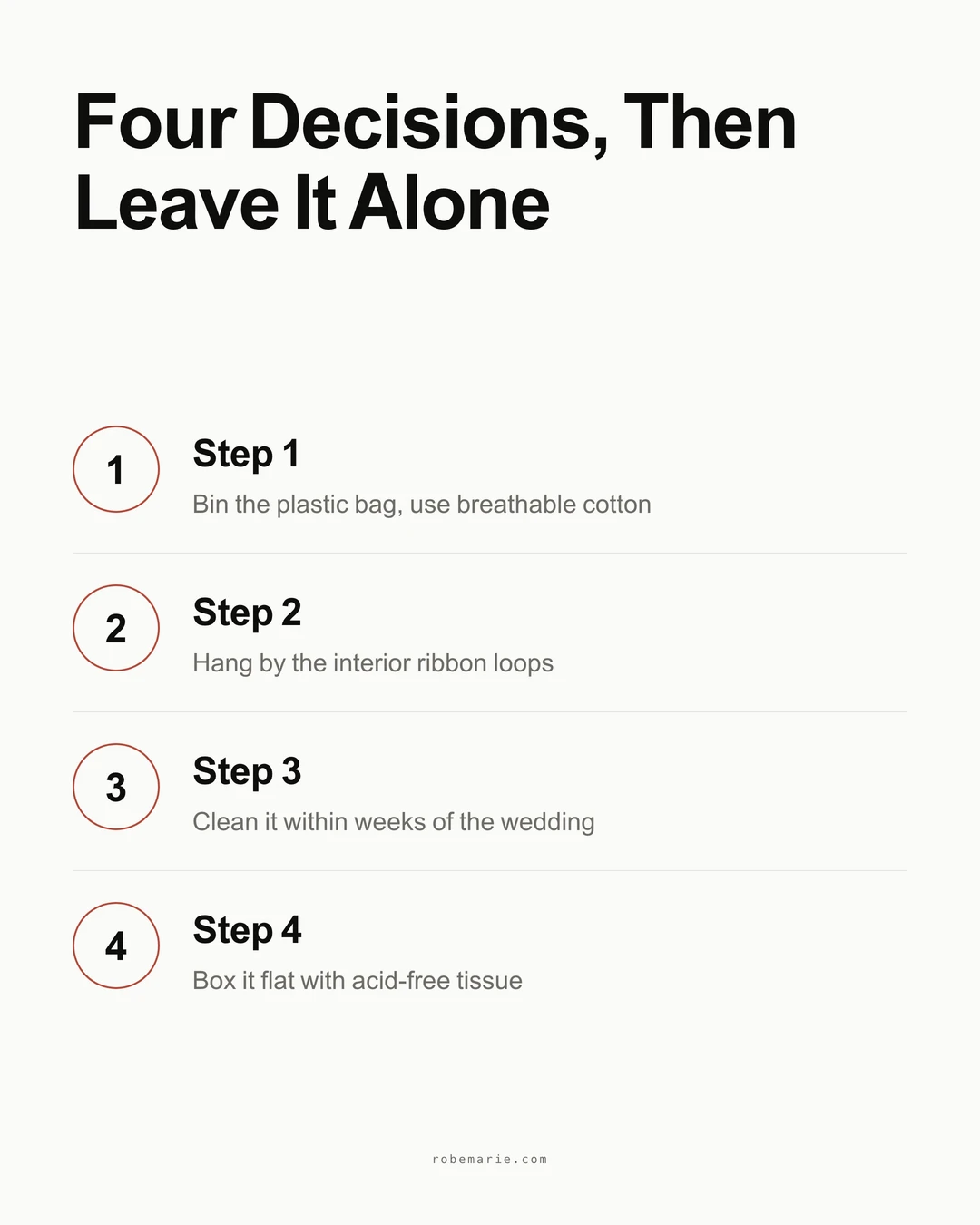
Four Decisions, Then Leave It Alone
Storing a wedding dress well is not a craft. It is four decisions: a wide shaped hanger using the interior loops, a cotton bag instead of plastic, an interior cupboard away from light and damp, and a professional clean within weeks of the wedding before anything gets boxed.
Then one habit: refold it every couple of years. That single ten-minute task is the difference between a gown that is still wearable in thirty years and one with permanent creases along four lines.
And if you have not chosen the dress yet, the storage question starts earlier than you think. Try RobeMarie's virtual try-on to see gowns on your own body before you buy, because the dress you were certain about is the one you will actually look after. For the rest of the day's details, our guide to the garter toss tradition and to bridal getting ready outfits cover what happens on either side of the gown.