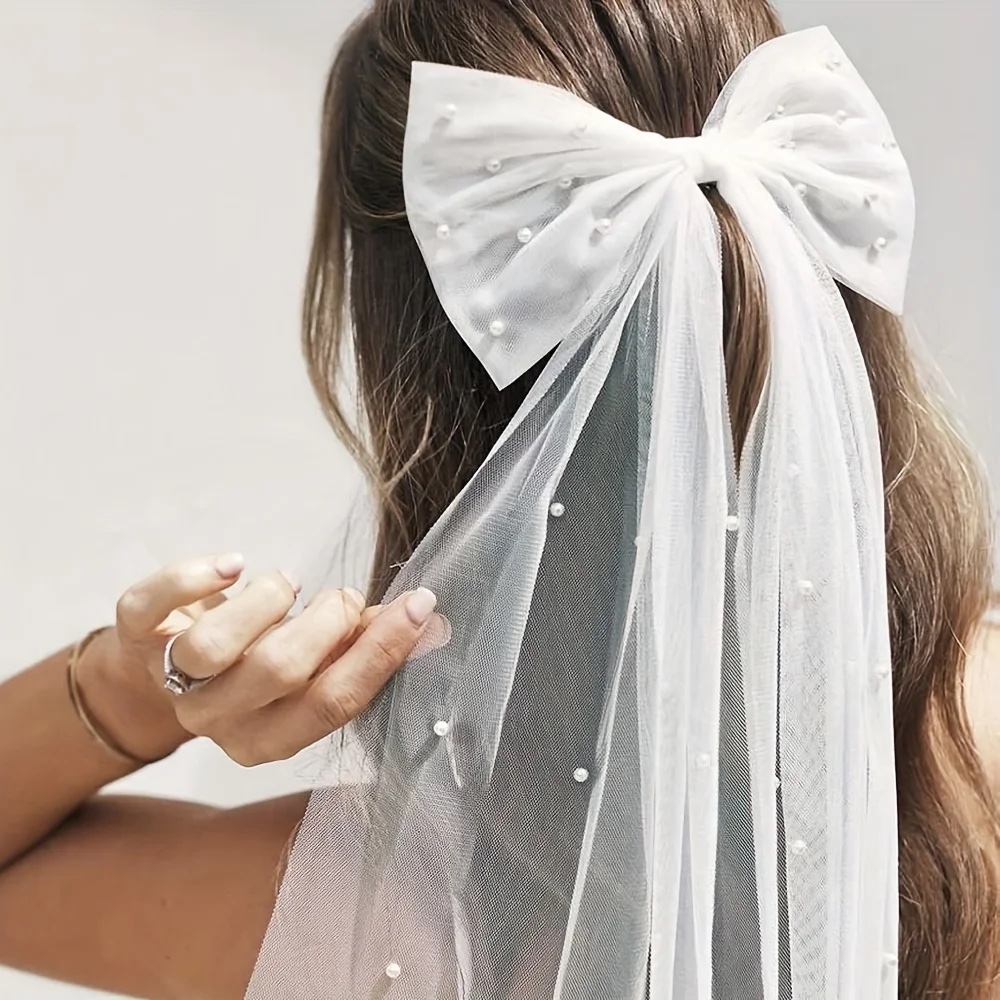
Scroll any 2026 wedding feed and one accessory keeps stopping the thumb: a bride photographed from behind, hair up, with an oversized tulle bow where a classic veil would start. The bow veil went from runway curiosity to the most requested bridal accessory in about two seasons, and unlike most viral wedding trends, it earned it. Here is what it actually is, why it works, and how to decide if it belongs in your look.
Key Takeaway: A bow veil is a short veil gathered into an oversized bow, usually soft tulle with a tail of 40 to 60 cm, fixed with a hidden comb. It costs $40 to $150 ready-made (boutique versions run well past that), works with almost every hairstyle, and photographs best from behind, which is exactly where classic mid-length veils do the least.
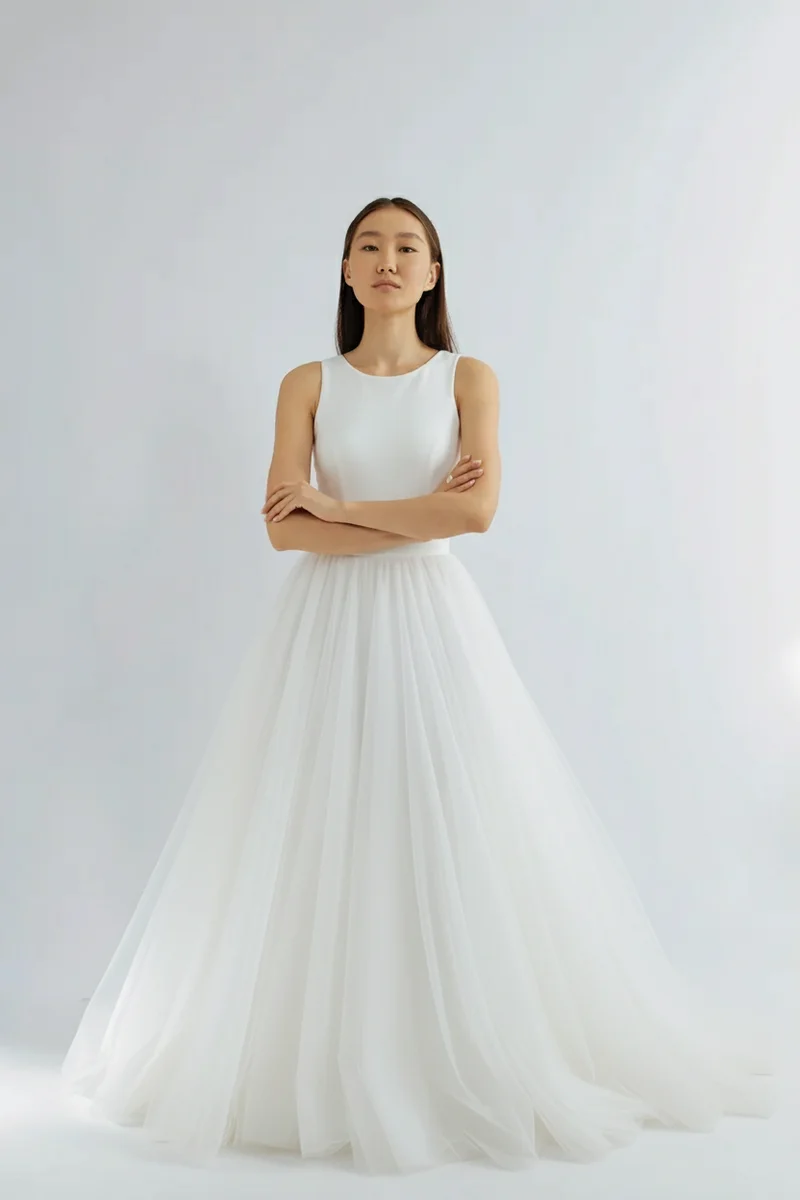
See this dress on you, before the boutique
Upload one photo and preview this style on yourself in seconds. No appointment, no pressure.
 Her photo
What is a bow veil?
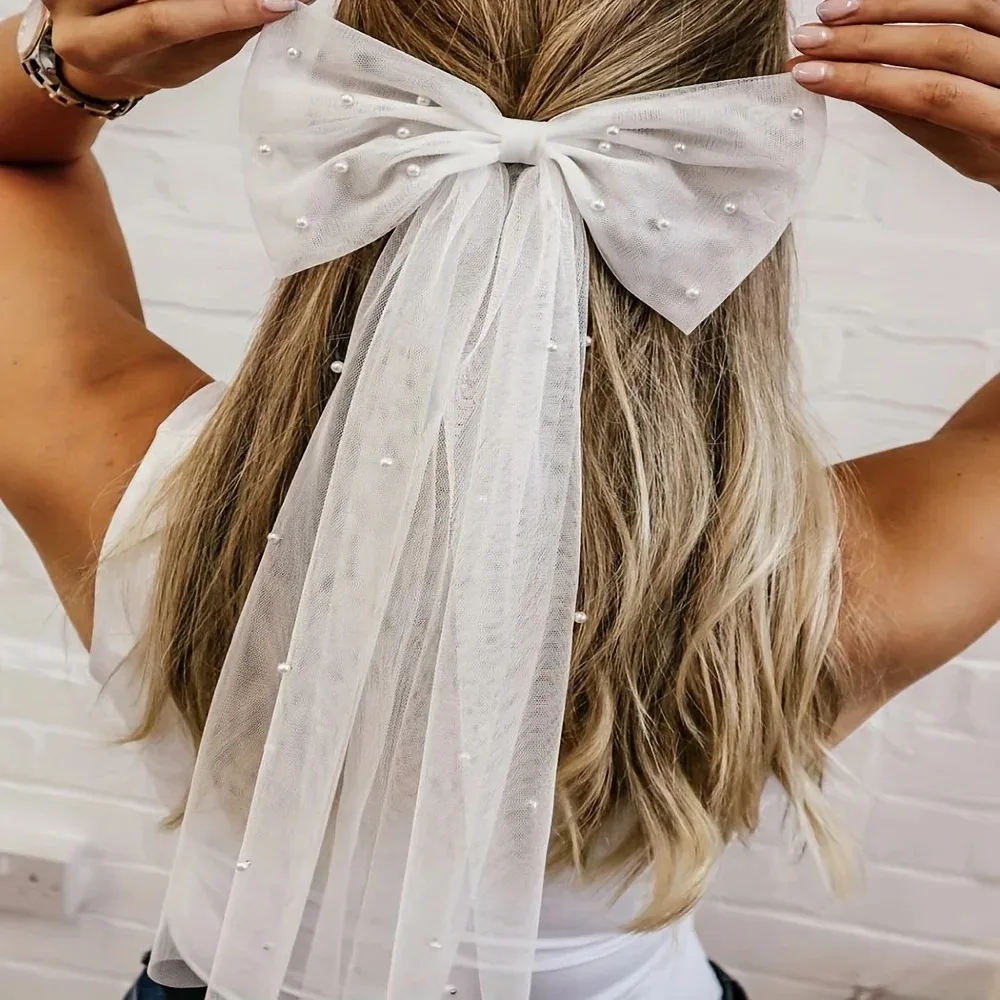
A bow veil is a wedding veil whose fabric is gathered into a large decorative bow at the back of the head, with a short tulle tail falling below it. Most versions attach with a hidden metal comb, the same mechanism as a traditional veil, so it clips in and holds without pins. Think of it as the veil moment condensed: the sheer fabric, the movement, the bridal silhouette, without metres of train to manage.
The shape traces back to the bows that took over bridal runways in 2024 and 2025 (Vivienne Westwood brides, coquette styling, the general return of ribbon everywhere). By 2026 the bow veil is the version that survived contact with real weddings, because it solved real problems: it does not drag, it does not need a stylist, and it stays put through a dance floor.
Why photographers love it (and why your album will too)
Here is the quiet flaw of most mid-length veils: from behind, they are a flat sheet of tulle. And yet the from-behind shot, walking down the aisle, first look, the ceremony wide shot, is one of the most repeated angles in any wedding album. A bow veil turns that angle into the best one. The bow gives the back of your head structure and intention; a version with pearl details catches the light every time you move.
There is a styling logic too: one strong accessory can carry a simple dress. A minimalist crepe slip gown plus an oversized bow reads as a complete, deliberate look. If your dress is already heavily detailed (lace, beading, statement back), a classic veil or a bare updo usually serves it better; a bow competing with an embellished back is the one combination that fails.
How to wear a veil with a bow, hairstyle by hairstyle
The bow veil is unusually forgiving because the comb sits flat against the head. What changes is the placement:
- Low bun or chignon: the classic pairing. Clip the bow just above the bun so the tail falls over it. This is the silhouette in most of the viral photos.
- Half-up: clip the comb under the gathered section, so the bow sits where the hair changes direction. Works especially well with soft waves below.
- Loose hair: place it at the crown-to-mid-back-of-head point, not too high. The bow floats on the hair; keep the front simple.
- Short hair or a bob: yes, it works, and it is one of the few veil styles that does. The bow reads as intentional structure rather than an anchor point for missing length.
Practical notes: push the comb in against the direction of the hair for grip, and if you want the party-only version, skip it for the ceremony and clip it in for the evening. It takes about ten seconds, which is why so many brides treat it as a second look for the price of an accessory.
What a bow veil costs, honestly
Ready-made bow veils in soft tulle run $40 to $150 online. Bridal boutique versions of the same construction (tulle, comb, sometimes pearls) are routinely priced from $150 to $400, and designer pieces go further. What you are paying for at the top end is a label, not a different object: the construction is a gathered tulle bow on a comb.
What is worth checking regardless of price: soft tulle rather than stiff (stiff tulle holds a shape but photographs like plastic), a metal comb rather than a plastic clip, and a bow wide enough to read on camera (around 20 cm). Pearl details are the one upgrade that earns its cost, because they photograph at every distance. That checklist is exactly how we chose the bow veil in our own shop, which covers it at $54 with free tracked shipping.
Bow veil or classic veil: how to decide
Choose a bow veil if your dress is simple, your hair is up or half-up, and you want the back of your look to be a feature. Choose a classic length (see our complete wedding veil guide for every option from birdcage to cathedral) if your ceremony is formal or religious, your dress back is the statement, or you want the full-length drama walking down the aisle.
And if you are still choosing the dress itself, settle that first: the veil decision becomes obvious once the dress exists. You can try dress styles on your own photo in a few seconds and see whether your silhouette wants a bow or a train behind it.
Frequently asked questions
What is a bow veil?
A bow veil is a short wedding veil gathered into an oversized bow, usually in soft tulle with a tail of 40 to 60 cm, attached with a hidden comb. It became the defining bridal accessory of 2025 and 2026 because it gives the veil moment without metres of fabric and photographs beautifully from behind.
Is the bow veil still in style for 2026?
Yes. The bow veil moved from runway trend to bridal staple across 2025 and 2026, the same path birdcage veils took a decade earlier. Because it solves practical problems (no train, no stylist, holds all night) it is settling in as a permanent option rather than fading with the trend cycle.
How much does a bow veil cost?
Ready-made bow veils cost $40 to $150 online, while bridal boutiques price comparable pieces from $150 to $400. The construction is the same: gathered tulle on a metal comb. Check for soft tulle, a metal comb and a bow around 20 cm wide rather than a brand name.
Can I wear a bow veil with my hair down?
Yes. Place the comb at the crown-to-mid-head point so the bow floats on the hair, and keep the front styling simple. Bow veils also work on short hair and bobs, which classic long veils struggle with.
Does a bow veil work for the ceremony or just the reception?
Both. Some brides wear it through the ceremony as their only veil; many others do the ceremony bare or with a classic veil, then clip the bow in for the evening. It attaches in seconds, so it doubles as a second look without an outfit change.
What dresses pair best with a bow veil?
Simple, clean-lined dresses: crepe slips, plain satin, minimalist column and A-line gowns. The bow supplies the statement. If your dress has an embellished back or heavy lace, a classic veil or no veil usually photographs better than two statements competing.